The 12 Best Healthcare Marketing Strategies for 2026
This guide breaks down 12 of the most effective medical marketing tactics that drive real growth, boost online visibility, and fill your appointment calendar with high-intent patients.
In 2026, medical marketing continues to evolve at lightning speed. With patients researching, comparing, and scheduling care online more than ever before, providers must stay ahead with bold, data-backed strategies tailored for their healthcare specialty.
Medical Marketing Strategies Comparison Table
| Strategy | Primary Goal | Main Channels | HIPAA Concerns | Automation Opportunity |
|---|---|---|---|---|
| 1. Website Optimization | Convert visitors into leads | Organic Search, Direct Traffic | ✅ HIPAA forms & tracking | Appointment booking, form alerts |
| 2. Social Media (Video) | Build trust & engagement | Instagram, Facebook, TikTok, YouTube | Minimal (if compliant) | Content scheduling, auto-subtitles |
| 3. Local SEO | Dominate “near me” searches | Google Maps, Organic Search | ✅ Google Business Profile | Review sync, citation management |
| 4. Google Ads | Drive booked appointments | Google Search, Google Maps | ✅ Landing page compliance | Conversion tracking, call tracking |
| 5. Retargeting Ads | Re-engage high-intent visitors | Meta, YouTube, Display Networks | ✅ Behavioral only | Audience segmentation, ad sequences |
| 6. Programmatic Display Ads | Brand omnipresence | Smart TV, Mobile, Web | ✅ No diagnosis-based ads | Real-time bidding, geofencing |
| 7. Patient Reviews | Build trust & improve SEO | Google, Facebook, Healthgrades | ✅ No PHI in replies | Automated post-visit requests |
| 8. Video Testimonials | Accelerate trust & conversions | Website, Social, Ads | ✅ Video release required | SMS/email requests, secure submissions |
| 9. E-Commerce for Self-Pay Treatments | Add new revenue stream | Website, Paid Ads | ✅ Secure checkout only | Cart flows, upsell automations |
| 10. Online Appointment Scheduling | Reduce friction, boost bookings | Website, Email, SMS | ✅ Scheduling software | Reminders, confirmations, integrations |
| 11. Physician Liaison Outreach | Increase referrals | In-person, Email, Print | ✅ Referral form compliance | CRM tracking, follow-up reminders |
| 12. Marketing Analytics | Optimize for ROI | All digital channels | ✅ Data security | Dashboards, lead source attribution |
Table of Contents
Top Performing Healthcare Marketing Strategies in 2026
If you’re looking for the best healthcare marketing strategies in 2026, the answer is not “do everything.” The best healthcare marketing strategies build a measurable system that removes friction between patient need and booking.
The data points below explain why healthcare marketing is increasingly digital-first:
- 65% of patients search online before contacting a doctor.
- Over 72% of healthcare ad budgets are allocated to digital channels.
- 70%+ of U.S. patients read online reviews when choosing a new provider.
- 72% only choose providers with 4-star ratings or higher.
Healthcare marketing strategies that win in 2026 combine website optimization, local organic search, Google Business Profile optimization, review management, video, PPC advertising, self-scheduling, programmatic display, and analytics.
1) Treat your website like your #1 digital asset (because it is)
A medical practice website is a patient acquisition asset. A strong medical website communicates what you treat, who provides care, why patients trust you, and how to schedule without confusion.
2026 winning requirements
- Website performance reduces bounce rate (mobile optimization can reduce bounce ~18%).
- HIPAA-compliant workflows protect patient trust.
- Machine-readable content improves discoverability across search and AI platforms.
Implementation checklist
- Clear appointment pathways improve website conversions.
- Visible provider profiles increase trust.
- Recognizable location pages support local SEO.
- Educational content answers symptoms and treatment questions.
- Booking flow completion under 2 minutes reduces drop-offs.
KPIs to track
- Booking conversion rate
- Mobile bounce rate
- Time-to-book completion
- Calls from click-to-call
Related Article: How to Increase Patient Volume in 2026
2) Make social media video-first (consistency beats perfection)
Video builds familiarity and video builds trust. Social media video shows the faces behind care, explains conditions, previews the clinic environment, and reduces fear around procedures.
Best practice
- Consistent posting creates consistent patient acquisition.
- Monthly batching creates sustainable content output.
Why short-form wins
- Short-form video under 60 seconds dominates healthcare social feeds in 2026.
3) Build local organic search dominance (patient volume lives here)
Local organic search drives patient volume. Local SEO increases appointment bookings by 32%.
Do this
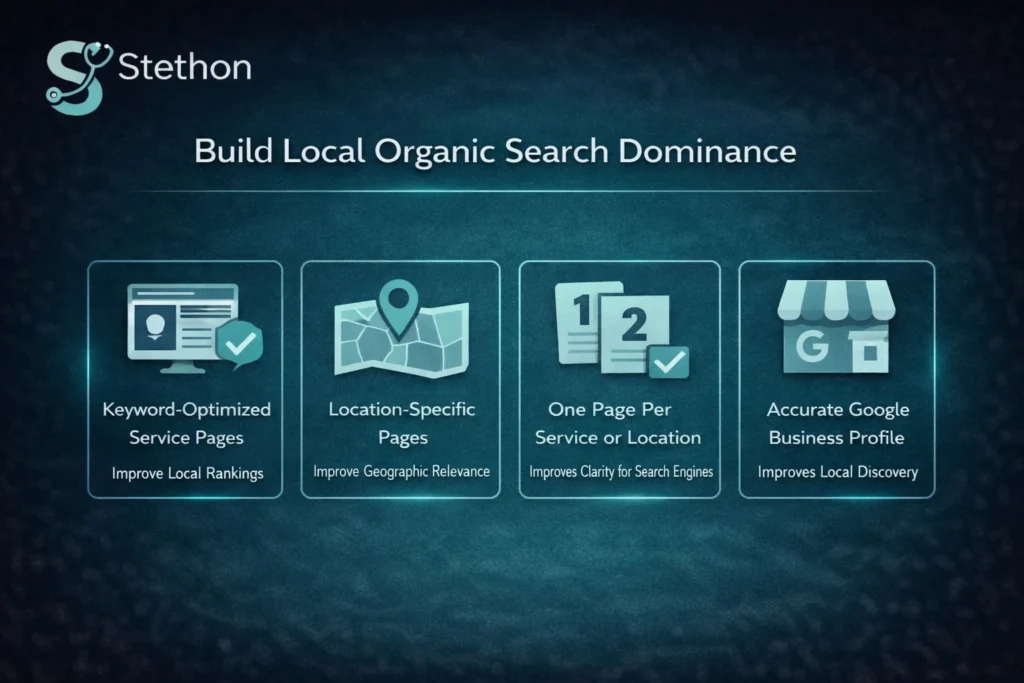
- Keyword-optimized service pages improve local rankings.
- Location-specific pages improve geographic relevance.
- One page per service or location improves clarity for search engines.
- An accurate Google Business Profile improves local discovery.
Example local intent queries
- “dermatologist for acne near me”
- “ankle specialist in [city]”
- “urgent care open now”
Read More: Medical SEO ROI: How Fast Will You See Results?
4) Optimize your Google Business Profile like it’s your homepage
Google Business Profile improves map pack visibility. Google Business Profile improves local conversions.
Profile fields to optimize
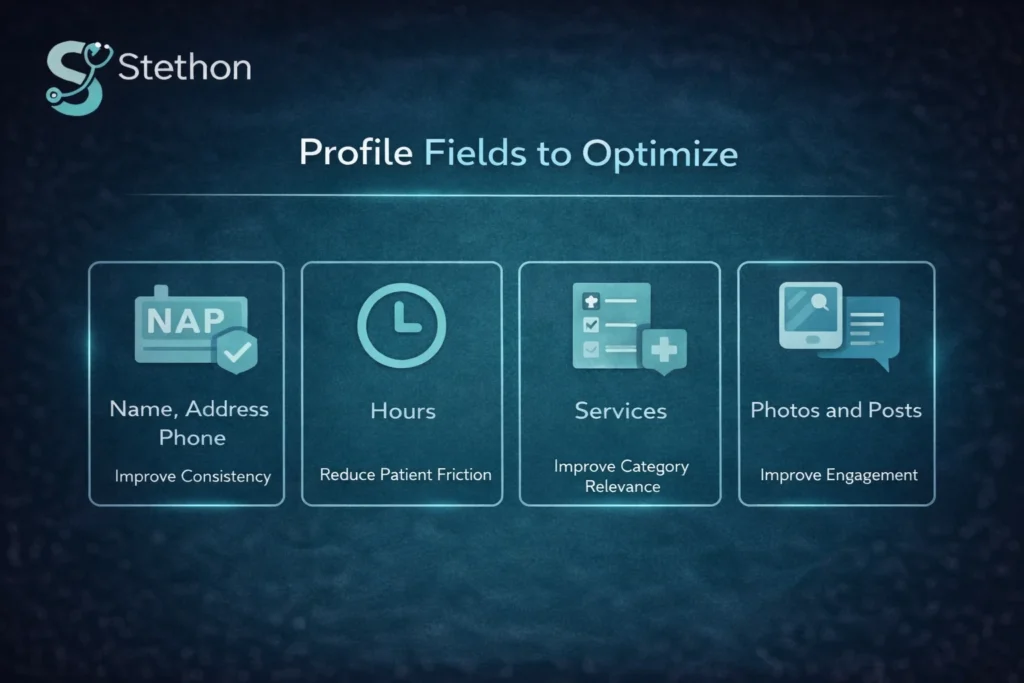
- Name, address, phone (NAP) improve consistency.
- Hours reduce patient friction.
- Services improve category relevance.
- Photos and posts improve engagement.
Local SEO support
- Directory citations (e.g., Yelp, Healthgrades) support local authority.
- Schema markup supports machine understanding.
5) Run Google Ads to capture high-intent patients at the moment of need
Google Ads captures high-intent patient acquisition. Google Ads reaches patients who are actively seeking care.
Performance references from the data
- Google Ads healthcare CPC is ~$4.71.
- Paid search conversion in healthcare is ~2.6%.
Best practice
- Landing pages improve PPC conversion rates.
- Trust signals improve landing page conversion rates.
- Scheduling buttons reduce booking friction.
6) Add Bing Ads for incremental reach and often lower costs
Bing Ads expands reach and Bing Ads can reduce CPC. Bing reaches desktop searchers and Bing often delivers cheaper clicks.
Bing references from the data
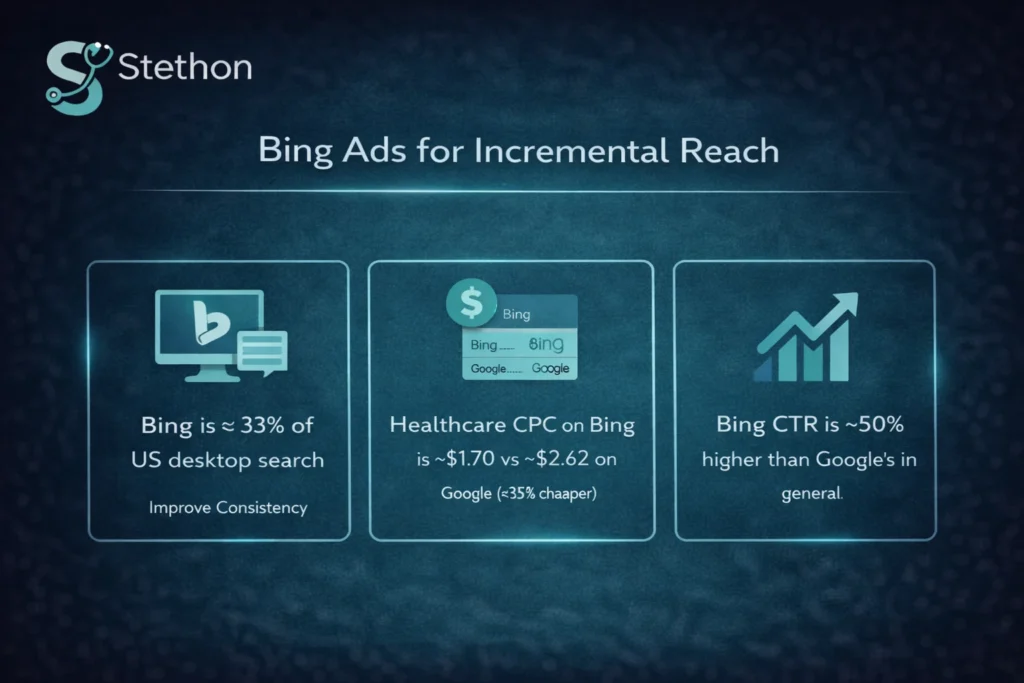
- Bing is ≈ 33% of US desktop search.
- Healthcare CPC on Bing is ~$1.70 vs ~$2.62 on Google (≈35% cheaper).
- Bing CTR is ~50% higher than Google’s in general.
Strategy
- Bing Ads plus Google Ads creates incremental patient acquisition.
Read More: The Best Healthcare Local SEO Companies of 2026
7) Retarget across search and social to recover “almost patients”
Remarketing increases second-chance conversions. Retargeting reaches visitors who did not book.
How to apply
- Service-page retargeting matches ads to intent.
- Testimonial ads increase trust on return visits.
- Clear booking CTAs increase conversion rates.
Tiktok Ads allow for efficient retargetting specially on clinics that manage to get a significant amount of views with their social media content creation strategies.
8) Win with reviews (they influence decisions before website visits)
Online reviews influence provider choice. Reviews affect patient trust and reviews affect local rankings.
Key trust behavior
- 70%+ read online reviews before choosing providers.
- 72% only choose doctors with 4-star ratings or higher.
Execution
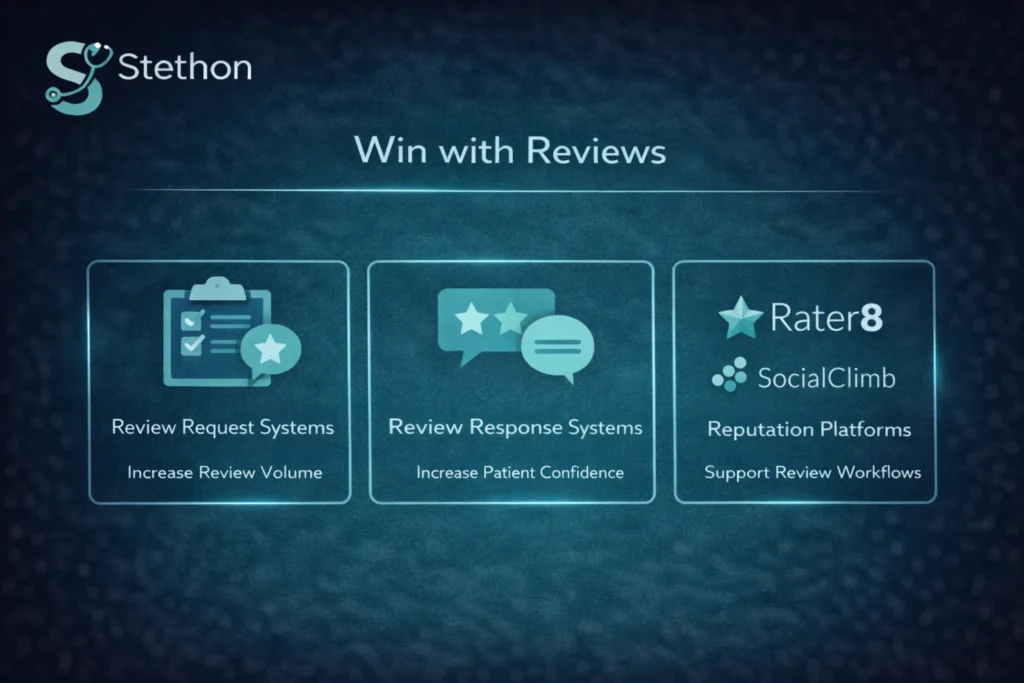
- Review request systems increase review volume.
- Review response systems increase patient confidence.
- Reputation platforms like Rater8 and SocialClimb support review workflows.
Bonus tactic (AI + search visibility)
- Procedure keywords in reviews increase machine readability and increase relevance for “best doctor for x” queries.

Read More: Google Reviews SEO: Map Pack Ranking Strategies in 2026
9) Use video testimonials to accelerate trust
Video testimonials increase trust. Video testimonials reduce uncertainty during the patient journey. Usually Youtube Ads perform better for trust building.
Where video testimonials work
- Service pages improve decision-making.
- Physician profile pages improve credibility.
Why it matters
- Emotional familiarity influences booking decisions.
Related Read: The Top Healthcare PPC Companies in 2026
10) Add e-commerce options to support self-pay models
E-commerce supports self-pay models. Online pricing and packaging reduce financial ambiguity.
What clinics can sell online
- Wellness visits
- Imaging
- Treatments
- Memberships
- DME
- Corrective therapies
Why it works
- Transparency increases patient action.
- Convenience improves conversion rates.
Explore: Programmatic Display Ads for Medical Businesses
11) Implement 24/7 self-scheduling to reduce referral leakage
Self-scheduling increases conversions. Self-scheduling reduces missed connections. Self-scheduling reduces referral leakage.
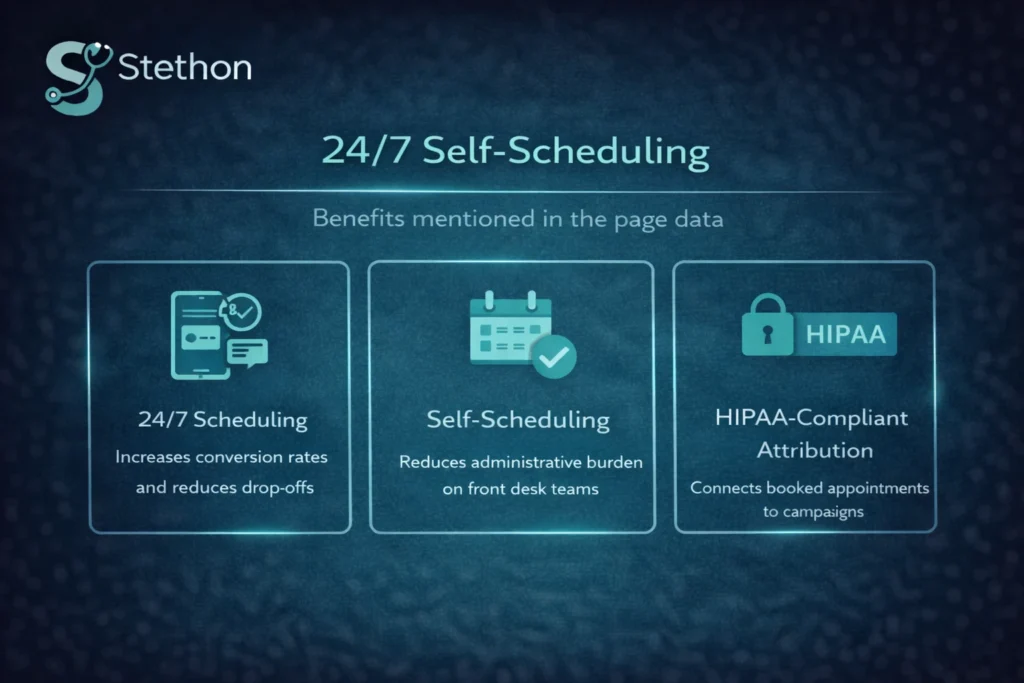
Benefits mentioned in the page data
- 24/7 scheduling increases conversion rates and reduces drop-offs.
- Self-scheduling reduces administrative burden on front desk teams.
- HIPAA-compliant attribution connects booked appointments to campaigns.
12) Combine referral outreach with analytics to make growth measurable
Physician liaison outreach strengthens referral networks. Referral partnerships increase case volume and referral partnerships increase long-term growth.
Metrics to track
- Retention rate
- Net referrer growth
- Churn rate (red flag if churn >10% in any quarter)
Analytics make growth repeatable. Analytics connect marketing to outcomes.
Track:
- Call conversion rate
- Appointment request volume
- Marketing lead sources
- Cost per acquisition
Native dashboards can help:
- Google Ads
- Google Analytics
- Google Search Console
Accurate attribution requires integrations that connect marketing channels to new patients, revenue, and lifetime value.
Explore: Healthcare Advertising Statistics for Clinics in 2026
SEO for Google AI Overviews and AI platforms (the 2026 visibility layer)
The consumer’s behavior is rapidly changing. Everyone is using AI tools to do research and compare clinics and services. Our Generative Engine Optimization Agency creates machine-readable information that improves AI discoverability. AEO/GEO improves AI citations and triggers recommendations by ChatGPT, Perplexity and Gemini.
Platforms mentioned
- Google AI Overviews
- Microsoft CoPilot
- LLMs like ChatGPT, Perplexity and Claude
- OpenAI
What these platforms favor
- Clear headings improve extraction.
- Structured text blocks improve summarization.
- Self-contained answers improve citations.
- Answer length of ~80–300 words improves usability (80 for quick answers, 300 for explainer paragraphs).
Practical site structure
- FAQ sections improve voice search visibility.
- Direct answers near the top improve AI retrieval.
- Simple language improves patient comprehension.
Related Article: The Top Healthcare Generative Engine Optimization Agencies for 2026
What these marketing strategies can do (6 Month Results)
A single-location psychiatry practice in a competitive US metro market improved visibility and booked intakes by combining local SEO, Google Business Profile optimization, review velocity, and LLM seedings to rank in the most used AI engines.
Map pack visibility improved from inconsistent rankings (#12–#20) to top 3 placement for 9 of 10 core “near me” keywords.
Google Business Profile actions increased significantly, with calls rising from 28 to 176 (+529%), direction requests from 9 to 56 (+522%), and website clicks from 33 to 241 (+630%).
Local organic traffic grew from 410 to 2,280 sessions per month (+456%), and appointment requests attributed to local search increased from 11 to 92 per month (+736%).
Lead response time improved from 20 hours to 1.8 hours, reducing drop-offs and increasing booked intakes from 14 to 81 per month (+479%). Results vary by market, capacity, and review velocity.

Read More: HIPAA Compliant Marketing Solutions for Doctors
The Top Digital Marketing Strategies Framework (2026)
| Metric (from this page’s data) | Number | Why it matters |
|---|---|---|
| Patients who search online before contacting a doctor | 65% | Your website + search presence are the first impression. |
| Healthcare ad budgets allocated to digital | 72%+ | Digital channels are where competition concentrates. |
| Patients who read reviews when choosing a provider | 70%+ | Reviews shape decisions before website visits. |
| Patients who only choose doctors with 4-star ratings or higher | 72% | Star ratings are a hard trust filter. |
| Local SEO impact on appointment bookings | +32% | Local organic search drives patient volume. |
| Patients who prefer online scheduling | 62% | Seamless 24/7 scheduling increases conversions. |
| Mobile optimization impact on bounce rates | ~18% reduction | Mobile UX protects SEO + paid traffic performance. |
| Patients expecting a response within 4–24 hours | 91% | Speed-to-lead is part of marketing now. |
| Average healthcare email open rate | ~41% | Email works when segmented and relevant. |
| Booked patients vs non-bookers: healthcare queries | 3× more | Patients need multiple touches before committing. |
| Patients expecting personalized messaging | 88% | Segmentation is no longer optional. |
What the modern patient journey looks like in 2026
Patients research across multiple channels before booking. Patients use search, social media, third-party sites, ads, and referrals. Patients who book search 3× more healthcare-related queries than those who don’t.
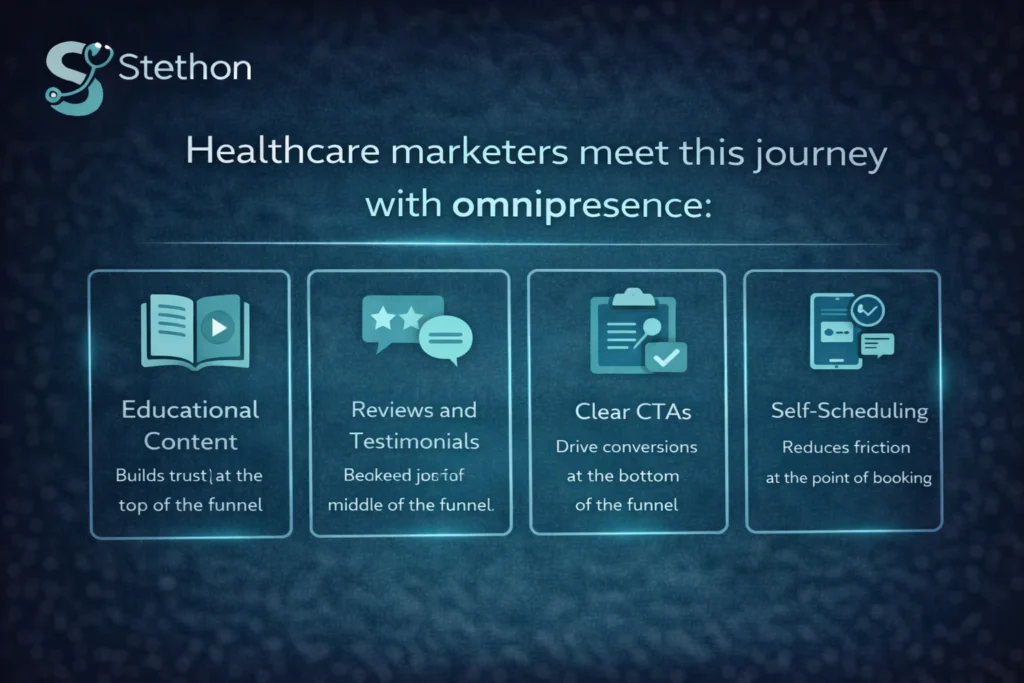
Healthcare marketers meet this journey with omnipresence:
- Educational content builds trust at the top of the funnel.
- Reviews and testimonials build trust in the middle of the funnel.
- Clear CTAs drive conversions at the bottom of the funnel.
- Self-scheduling reduces friction at the point of booking.
Meta ads are usually the top of the funnel and middle of the funnel, while google ads are usually better suited for bottom of the funnel local service ads.
Frequently Asked Questions (FAQ)
What are the best healthcare marketing strategies in 2026?
The best healthcare marketing strategies in 2026 combine a fast, patient-friendly website with local organic search, a complete Google Business Profile, strong reviews, conversion-focused Google Ads and Bing Ads, video-first social media, 24/7 self-scheduling, and analytics that connect marketing to booked appointments.
Why is local SEO considered one of the best healthcare marketing strategies?
Local SEO increases appointment bookings by 32%. Local organic search becomes a predictable source of calls and online appointment requests when service pages, location pages, and Google Business Profile optimization work together.
Why do reviews matter so much for healthcare marketing?
Reviews influence patient choices before website visits. 70%+ of patients read reviews and 72% of patients only choose doctors with 4-star ratings or higher.
What makes PPC effective for medical marketing strategies?
PPC targets high-intent searches and PPC drives patient acquisition. Google Ads in healthcare shows ~$4.71 CPC and ~2.6% conversion in the provided data. Bing Ads can lower costs and expand desktop reach.
How do I use AI platforms like Google AI Overviews, ChatGPT, and Perplexity as part of my digital marketing strategy?
Treat AI platforms like Google AI Overviews, ChatGPT, and Perplexity as an additional discovery channel that amplifies your existing SEO, not as a separate marketing program. These systems pull answers from web pages they can easily interpret and trust, so the goal is to make your website and local presence “extractable” and credible.
About Stethon Digital Marketing
Stethon Digital Marketing publishes healthcare marketing content focused on measurable patient acquisition through SEO, PPC, reviews, scheduling conversion, and analytics.
In 2026, the best healthcare marketing strategies match modern patient research behavior, reduce scheduling friction, build trust through reviews and testimonials, stay visible through SEO and PPC, support AI-readable content for Google AI Overviews and LLMs, and use analytics to turn growth into a repeatable process.