100+ Neuropathy Advertising Statistics in 2026 (Backed by Data)
This research report compiles 100+ neuropathy marketing statistics for 2026 across neurology clinics, pain management centers, diabetic foot practices, and specialty providers treating peripheral neuropathy.
Table of Contents
Neuropathy Marketing Statistics in USA
- 40.1 million Americans live with diabetes.
- 12.0% of the U.S. population has diabetes.
- 115.2 million U.S. adults have prediabetes.
- 13.5% neuropathy prevalence in U.S. adults 40+.
- 26.8% neuropathy prevalence in adults 70+.
- 68.1% chemotherapy-induced neuropathy at 1 month.
- 7–10% neuropathic pain prevalence in the general population.
- 160,000+ diabetes-related amputations annually.
- $26.2B projected U.S. healthcare digital ad spend in 2026.
- 97% of consumers read online reviews before choosing a business.
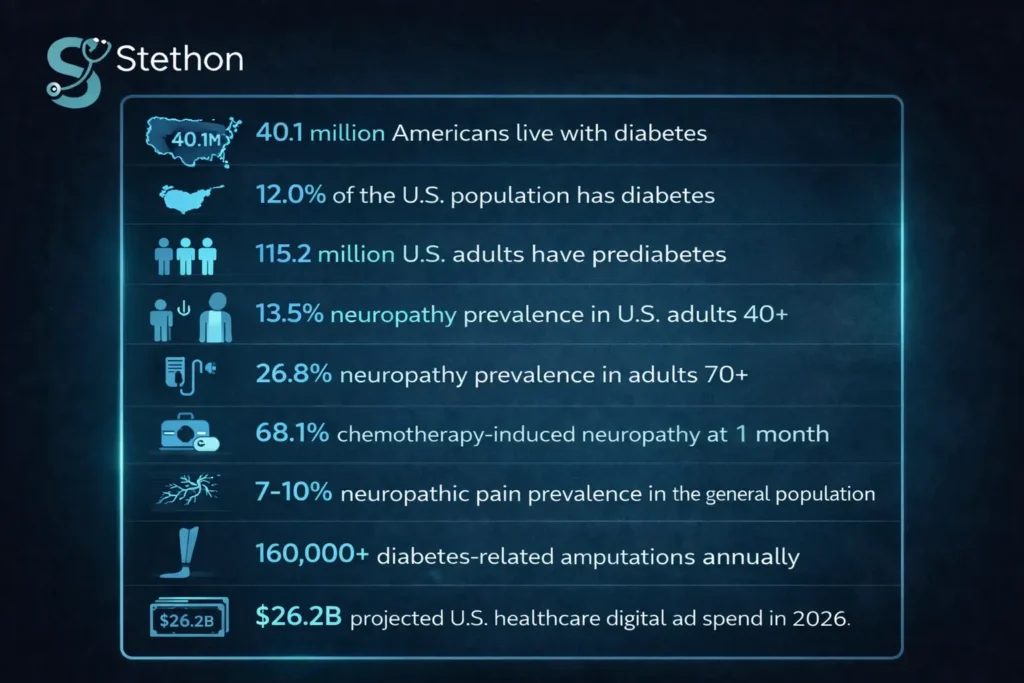
Neuropathy demand is not niche. It is structurally supported by large upstream populations.
Interpretation: Neuropathy marketing operates inside a massive demand environment. The constraint is not awareness alone, but structured visibility, trust, and intake performance.
I. Demand Drivers and Clinical Segments That Shape Marketing
Diabetes-Driven Neuropathy Demand
- Roughly half of people with diabetes develop nerve damage over time.
- Up to 50% of diabetic neuropathy cases are asymptomatic.
- 19–34% lifetime risk of diabetic foot ulcer.
- 28.4% neuropathy prevalence in adults 40+ with diabetes.
- 11.8% neuropathy prevalence in adults 40+ without diabetes.
Interpretation: Neuropathy clinics must market into the diabetes pipeline. Screening education and prevention messaging expand top-of-funnel reach.
Oncology Survivorship Segment
- 20 million new global cancer cases annually.
- 53.5 million people alive within five years of cancer diagnosis.
- 68.1% CIPN prevalence at 1 month post-chemotherapy.
- 60.0% at 3 months.
- 30.0% at 6 months.
Interpretation: Oncology-related neuropathy is a predictable referral stream. SEO and PPC campaigns targeting chemotherapy-induced neuropathy create segmented acquisition channels.
Idiopathic and Other Causes
- 25–46% of neuropathy cases are idiopathic.
- Post-herpetic neuralgia occurs in 10–18% of shingles cases.
- HIV-related neuropathy prevalence reported between 30–67% in literature ranges.
Interpretation: Content must address causes, uncertainty, and diagnostic pathways to reduce drop-off in confused patient segments.
II. Symptom-First Search Behavior
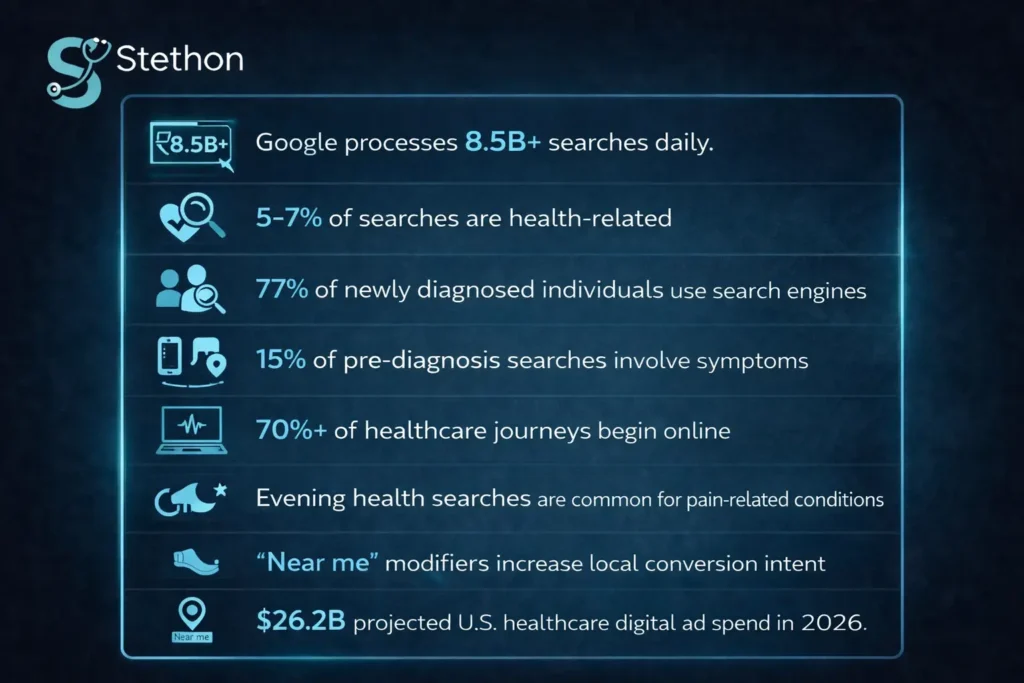
Patients search symptoms before they search clinics.
- Google processes 8.5B+ searches daily.
- 5–7% of searches are health-related.
- 77% of newly diagnosed individuals use search engines.
- 15% of pre-diagnosis searches involve symptoms.
- 70%+ of healthcare journeys begin online.
- Evening health searches are common for pain-related conditions.
- “Near me” modifiers increase local conversion intent.
Interpretation: Neuropathy SEO must target burning feet, tingling toes, numb hands, and night-time pain queries before competing for “neuropathy specialist” keywords.
Quick Read: The 25 Best Chiropractic Ads in 2026 To Get More Patients
III. AI Visibility and Structured Content
- 30% of some queries trigger AI-generated summaries.
- 53% of users report seeing AI overviews in search.
- Structured headings increase AI extraction accuracy.
- FAQ schema improves snippet eligibility.
- Author transparency increases trust scoring.
- Clear service pages improve summarization probability.
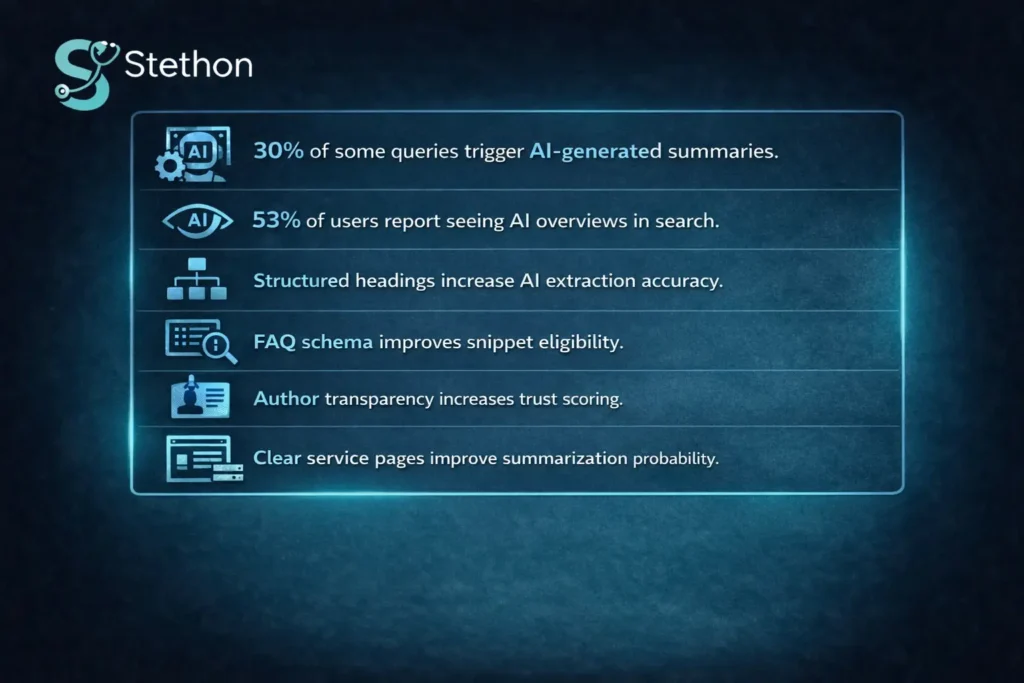
Interpretation: Neuropathy content must be structured, data-backed, and professionally presented to maintain AI-era visibility.
IV. Social Media Exposure
- 84% of U.S. adults use YouTube.
- 71% use Facebook.
- 50% use Instagram.
- 55% use social media occasionally for health information.
- 15% rely on influencers for health advice.
- 61% distrust influencer motivations.
- Fewer than 10% trust most health information seen on social platforms.
Interpretation: Social media in neuropathy marketing is best used for clinician-led education and retargeting, not aggressive claims.
Related Article: 25 Best Ads for Neuropathy Clinics in 2026
V. Reviews and Reputation as Conversion Gates
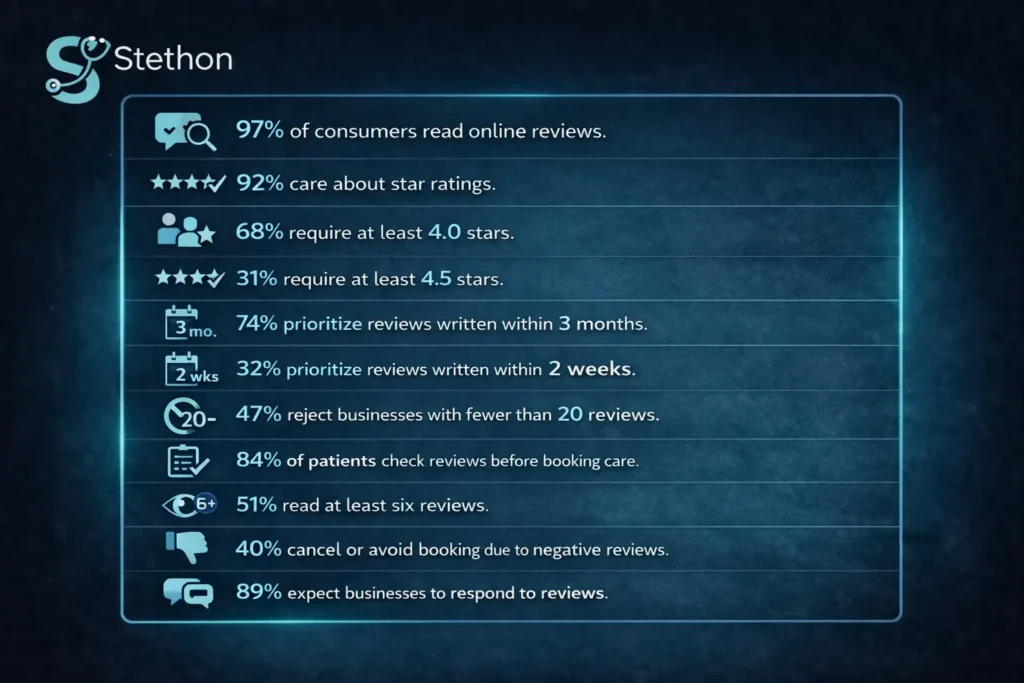
- 97% of consumers read online reviews.
- 92% care about star ratings.
- 68% require at least 4.0 stars.
- 31% require at least 4.5 stars.
- 74% prioritize reviews written within 3 months.
- 32% prioritize reviews written within 2 weeks.
- 47% reject businesses with fewer than 20 reviews.
- 84% of patients check reviews before booking care.
- 51% read at least six reviews.
- 40% cancel or avoid booking due to negative reviews.
- 89% expect businesses to respond to reviews.
Review Threshold Table
| Metric | Behavioral Impact |
|---|---|
| 4.0+ stars | Minimum for majority consideration |
| 4.5+ stars | Required by one-third of consumers |
| 20+ reviews | Common minimum volume threshold |
| 3-month recency | Critical for decision confidence |
Interpretation: Reputation is an eligibility filter in neuropathy marketing. Without volume, recency, and response strategy, acquisition efficiency collapses.
VI. Scheduling and Conversion Realities
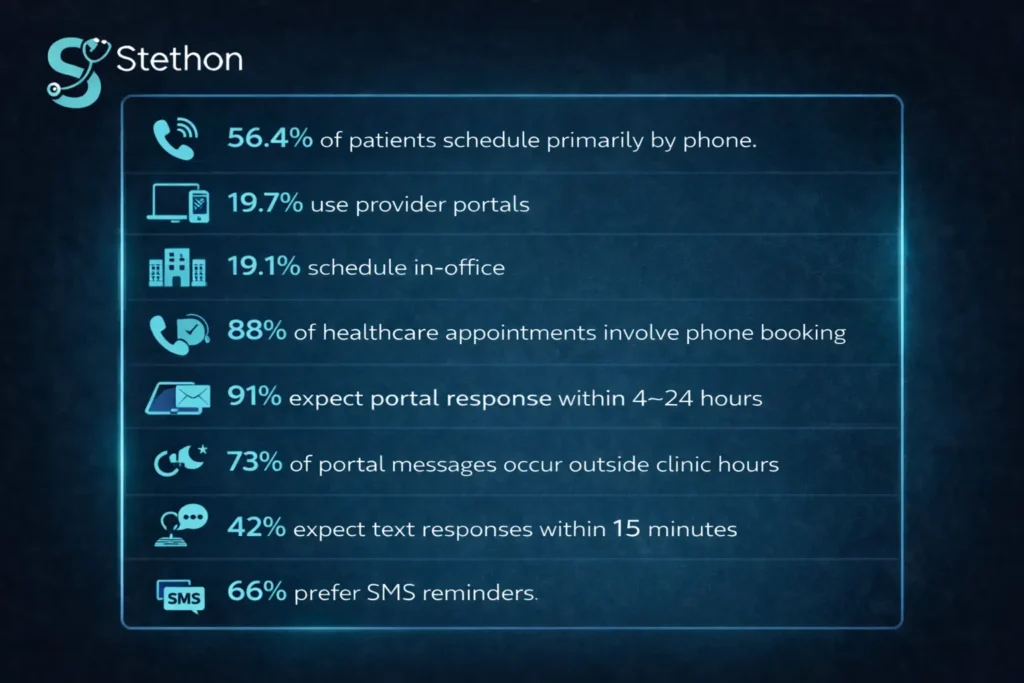
- 56.4% of patients schedule primarily by phone.
- 19.7% use provider portals.
- 19.1% schedule in-office.
- 88% of healthcare appointments involve phone booking at some stage.
- 91% expect portal response within 4–24 hours.
- 73% of portal messages occur outside clinic hours.
- 42% expect text responses within 15 minutes.
- 66% prefer SMS reminders.
Scheduling Split Table
| Scheduling Method | Primary Usage |
|---|---|
| Phone | 56.4% |
| Portal | 19.7% |
| In-office | 19.1% |
| Apps | ~2% |
Interpretation: Phone answer rate, speed-to-response, and after-hours workflows are core marketing variables in neuropathy acquisition.
VII. Access Friction
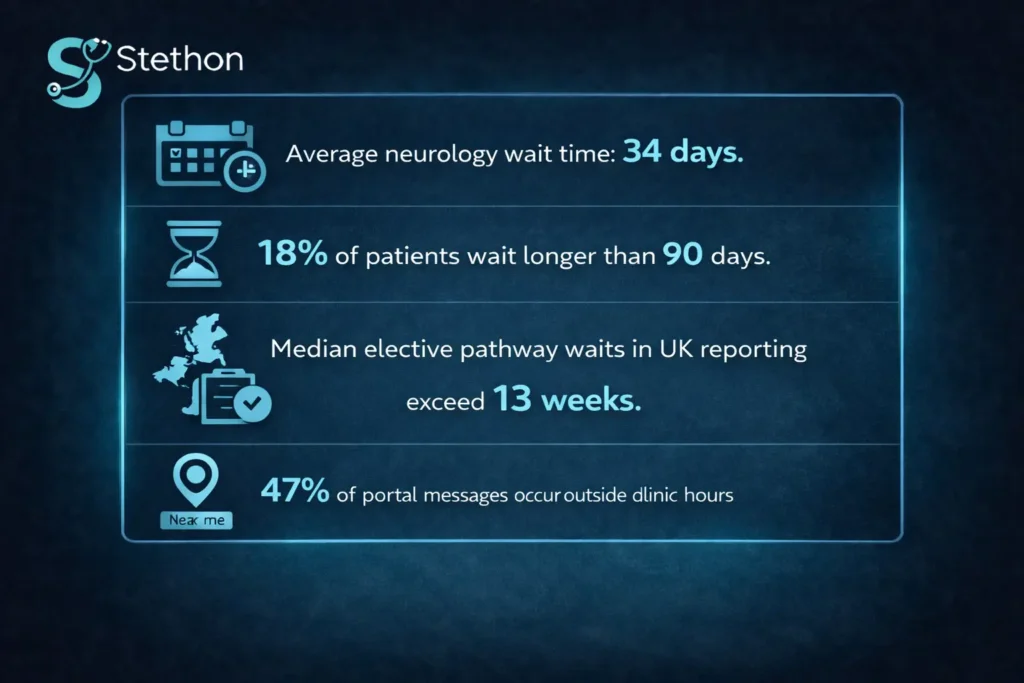
- Average neurology wait time: 34 days.
- 18% of patients wait longer than 90 days.
- Median elective pathway waits in UK and US reporting exceed 13 weeks.
Interpretation: Long waits increase competitive shopping behavior. Clinics that clarify availability and intake steps convert better.
VIII. Paid Media Economics
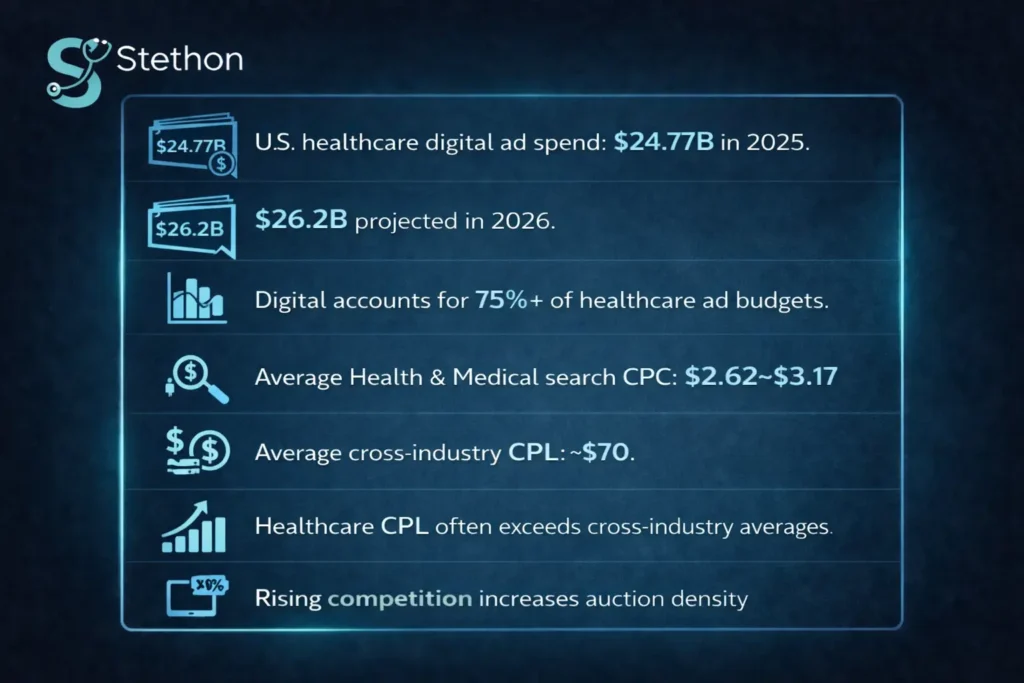
- U.S. healthcare digital ad spend: $24.77B in 2025.
- $26.2B projected in 2026.
- Digital accounts for 75%+ of healthcare ad budgets.
- Average Health & Medical search CPC: $2.62–$3.17.
- Average cross-industry CPL: ~$70.
- Healthcare CPL often exceeds cross-industry averages.
- Rising competition increases auction density.
Paid Media Efficiency Table
| Variable | Marketing Impact |
|---|---|
| CPC increase | Raises cost per booked consult |
| Call conversion +5% | Disproportionate ROI gain |
| Show rate +10% | Reduces effective CAC |
Interpretation: Neuropathy PPC profitability depends more on conversion systems than click price alone.
IX. Channel-Specific Commercial Layers
Neuropathy Local SEO
- Local intent searches convert at higher rates than generic searches.
- Map pack visibility drives call-heavy engagement.
- Review velocity influences local ranking stability.
- Recency signals influence map pack trust.
Interpretation: Neuropathy Local SEO must prioritize Google Business Profile optimization, review acquisition systems, and location-specific symptom pages.
Neuropathy Local SEO Service Table
| What We Deliver | What It Improves | Why It Matters |
|---|---|---|
| Google Business Profile optimization | Map pack visibility | Patients shortlist in Maps |
| Review acquisition + response playbook | Trust + conversion | Reviews are eligibility gates |
| Service/category completeness | Click-to-call rate | Incomplete profiles lose patients |
| Location + symptom landing pages | Organic capture | Symptoms drive search demand |
| Listing consistency checks | Ranking stability | Reduces confusion in local signals |
Neuropathy PPC
- Symptom keywords capture top-of-funnel urgency.
- Condition keywords capture diagnostic intent.
- Call-only campaigns increase urgent booking capture.
- Negative keyword filtering improves cost efficiency.
Interpretation: Neuropathy PPC campaigns must be structured by symptom stage and optimized for phone-first landing pages.
You’re interested: The Top Chiropractic Marketing Agencies in the US in 2026
Neuropathy PPC Service Table
| PPC Component | Goal | Clinic Outcome |
|---|---|---|
| Symptom keyword clusters | Capture urgent intent | More qualified calls |
| Tight geo + schedule controls | Reduce waste | Better CPL stability |
| Call-first landing pages | Raise CVR | More bookings per click |
| Call tracking + recordings | Diagnose leaks | Higher booked appointment rate |
| Negative keyword system | Reduce bad clicks | Lower wasted spend |
Neuropathy Google Ads
- Search campaigns capture bottom-funnel intent.
- Brand campaigns protect existing demand.
- Impression share loss impacts competitive visibility.
- Call extensions increase conversion rates.
Interpretation: Neuropathy Google Ads success depends on segmentation, call tracking, and intake alignment.
Neuropathy Google Ads Service Table
| Campaign Layer | Purpose | Why It Works |
|---|---|---|
| Symptom Search | Capture early intent | Patients search symptoms first |
| “Near me” + Local | Capture booking intent | Local intent converts fast |
| Condition-specific ad groups | Improve relevance | Higher CTR and CVR |
| Call-only / call assets | Drive phone bookings | Scheduling is phone-led |
| Brand defense | Protect demand | Prevent competitor hijack |
Related Read: Reputation Management for Neuropathy in 2026
Neuropathy Facebook Ads
- Facebook remains one of the largest reach platforms.
- Retargeting increases conversion probability.
- Educational video ads increase trust engagement.
- Social proof creatives improve click-through rates.
Interpretation: Facebook Ads in neuropathy marketing are most effective for retargeting and mid-funnel education.
Neuropathy Facebook Ads Service Table
| Creative Type | Funnel Role | Best Use Case |
|---|---|---|
| Short clinician-led education | Awareness | “Is this neuropathy?” stage |
| Testimonials / outcomes | Trust | Reduces skepticism |
| Retargeting sequences | Conversion assist | Helps close comparison shoppers |
| Lead forms vs landing pages | Friction control | Market-dependent testing |
Neuropathy TikTok Ads
- Short-form educational content increases awareness.
- Caregiver-targeted content performs well in chronic-care niches.
- Younger diabetic audiences are present on TikTok.
Interpretation: TikTok works best for awareness and caregiver education, not direct cold conversion.
TikTok Ads Service Table
| TikTok Asset | Why It Works | Primary Outcome |
|---|---|---|
| 15–25s symptom hooks | Scroll-stopping format | Cheap reach + awareness |
| “3 signs” videos | Fast pattern recognition | More qualified traffic later |
| Caregiver targeting | Strong motivator | Higher inquiry intent |
| Retarget-to-book flow | Bridges trust gap | Assisted conversions |
Neuropathy YouTube Ads
- YouTube reaches 84% of U.S. adults.
- Video explainers improve perceived expertise.
- Patient testimonial videos increase conversion likelihood.
- Skippable in-stream ads reduce CPM.
Interpretation: YouTube Ads bridge education and credibility, especially for high-ticket neuropathy programs.
YouTube Ads Service Table
| Video Asset | KPI Focus | Why It Matters |
|---|---|---|
| Doctor-led explainer | VTR / view rate | Builds authority fast |
| Patient story creative | Assisted conversion | Proof beats claims |
| “First visit” walkthrough | Click intent later | Reduces intake friction |
| Viewer retargeting | CPA stability | Warms future search traffic |
X. Funnel Modeling Example
- Example CPC: $3.00.
- Landing page call conversion: 12%.
- Call-to-book rate: 35%.
- Show rate: 70%.
- 100 clicks → ~3 attended consults (modeled scenario).
Funnel Stage Table
| Funnel Stage | Estimated Volume |
|---|---|
| Clicks | 100 |
| Calls | 12 |
| Booked | 4.2 |
| Attended | 2.94 |
Interpretation: Small improvements in call handling or show rate materially shift neuropathy marketing ROI.
XI. KPI Dashboard for Neuropathy Marketing
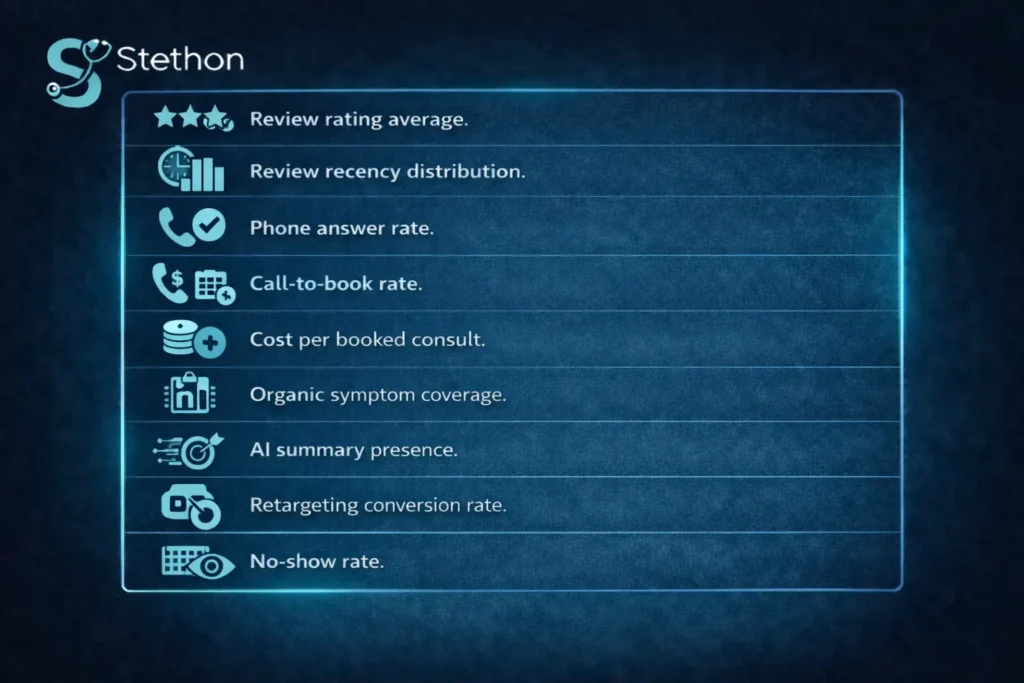
- Review rating average.
- Review recency distribution.
- Phone answer rate.
- Call-to-book rate.
- Cost per booked consult.
- Organic symptom coverage.
- AI summary presence.
- Retargeting conversion rate.
- No-show rate.
- Impression share.
Interpretation: Neuropathy growth requires integrated tracking across SEO, PPC, reviews, and intake systems.
XII. Neuropathy Marketing Trends for 2026
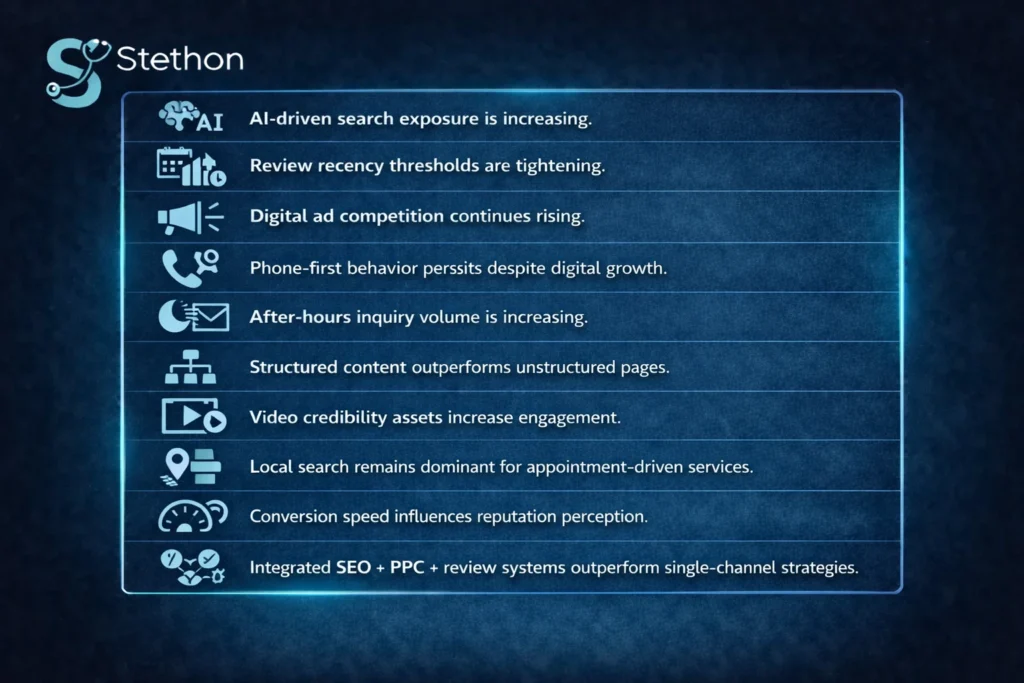
- AI-driven search exposure is increasing.
- Review recency thresholds are tightening.
- Digital ad competition continues rising.
- Phone-first behavior persists despite digital growth.
- After-hours inquiry volume is increasing.
- Structured content outperforms unstructured pages.
- Video credibility assets increase engagement.
- Local search remains dominant for appointment-driven services.
- Conversion speed influences reputation perception.
- Integrated SEO + PPC + review systems outperform single-channel strategies.
Interpretation: The highest-performing neuropathy clinics in 2026 combine structured Local SEO, segmented Google Ads, generative engine optimization inquiries, and phone-first intake optimization.
Methodology & Sources
This report synthesizes benchmark data plus aggregated performance data from Stethon Digital Marketing client campaigns. All calculated values use simple arithmetic based on referenced benchmarks.
Editorial Disclaimer
This report is an editorial benchmark reference. It is not medical advice, legal advice, or a guarantee of results. Advertising performance varies by geography, offer, compliance constraints, tracking quality, and operational execution.
Executive Summary
Neuropathy marketing in 2026 is defined by three measurable forces: symptom-first search behavior, review-gated trust thresholds, and phone-first scheduling under real access constraints. Demand is structurally large, supported by diabetes-scale populations and age-driven prevalence, while digital competition continues to rise with healthcare ad spend expanding into 2026. In this environment, performance is constrained less by awareness and more by visibility, reputation strength, and intake execution, because the clinics that win tend to convert trust into appointments faster than competitors.