This guide explains reputation management for mental health clinics in a practical, privacy-first way. It covers how reputation actually works, which platforms matter, and which strategies protect credibility while improving visibility.

If you are researching mental health clinics reputation management services or looking to understand reputation management for mental health professionals, this article is for you.
Reputation is not a side concern for mental health clinics. It is a deciding factor.
Before a prospective patient calls, books, or fills out a form, they almost always search online. They read reviews, scan ratings, check credentials, and form a judgment in seconds. For mental health clinics, that judgment is less about price or convenience and more about trust, safety, and professionalism.
Top 10 reputation management strategies for mental health clinics in 2026
Below are the most effective reputation management strategies used by successful mental health clinics.
Reputation strategies overview
| Strategy | Primary Goal | Platform Focus | Confidentiality Notes |
|---|---|---|---|
| Review velocity system | Build recent trust signals | Google Reviews | Neutral, optional requests |
| Google Business optimization | Improve visibility | Google Maps | No patient disclosure |
| Review response framework | Show professionalism | Public platforms | No confirmation of care |
| Directory consistency | Reduce confusion | Healthcare directories | Accurate clinic data |
| Feedback routing | Resolve issues privately | Internal systems | Protect identities |
| Front desk training | Prevent dissatisfaction | Phone and scheduling | Tone and clarity |
| “What to expect” content | Reduce anxiety | Website | Educational only |
| Monitoring alerts | Catch issues early | All platforms | Calm, consistent responses |
| Credential visibility | Improve confidence | Website and profiles | Factual information |
| System integration | Tie reputation to growth | SEO and PPC | Trust before conversion |
More Mental Health Facts: 50+ Mental Health Marketing Statistics for 2026 (Backed by Data)
Table of Contents
1. Build review velocity, not review spikes
Consistent review activity signals reliability and reduces the impact of isolated negative feedback. Instead of running occasional review drives, mental health clinics benefit from a steady system that invites feedback at natural milestones such as completed intakes, program progress points, or successful discharges. Using one primary review destination, most often Google Reviews, helps consolidate trust signals and improve local visibility.
Neutral review requests work best in mental health settings. Avoid incentives, avoid coaching patients on what to say, and keep the message optional and respectful. Review velocity also supports Google Maps performance, as recency becomes a credibility signal for both patients and search engines.
Related Article: Google Reviews SEO: Map Pack Ranking Strategies in 2026
2. Optimize Google Business Profile regularly
Accurate Google Business Profiles increase trust and improve local search visibility. This is a top priority when doing mental health local seo. Clinics should review their profile monthly to confirm hours, holiday schedules, phone routing, and appointment links. Service categories should reflect actual offerings such as therapy, psychiatry, assessments, or telehealth, rather than generic labels.
Professional photos of the clinic environment and staff help reduce uncertainty and make the listing feel real. A well-maintained Google Business Profile reduces confusion-driven complaints and supports stronger map pack placement for searches like “mental health clinic near me.”
Quick Read: Best Ads for Psychiatrists in 2026
3. Use a privacy-safe response framework
Public professionalism matters more than public explanations. Mental health clinics should use a consistent response framework that thanks the reviewer, reinforces standards of care, and invites private contact without confirming any patient relationship. This approach protects confidentiality while demonstrating accountability.
Creating a short internal SOP for review responses ensures tone consistency across staff members. Calm, minimal responses reduce legal and ethical risk while signaling stability to prospective patients reviewing the clinic online.
Read More: How to Make Your Email HIPAA Compliant in 2026
4. Standardize listings across directories
Inconsistent listings create friction that often leads to negative reviews. Clinics should audit name, address, and phone number consistency across Google, healthcare directories, and high-visibility platforms. Duplicate listings should be merged or removed to prevent confusion.
Standardized local citations improve both reputation and mental health local SEO. When patients encounter accurate information everywhere, they experience fewer dead ends, missed appointments, and frustration-driven complaints.
5. Treat front desk experience as reputation management
Many reputation issues originate before clinical care begins. Front desk tone, call handling, and scheduling clarity directly influence online feedback. Clinics benefit from simple scripts that address common questions about intake, insurance, availability, and next steps.
Clear communication reduces anxiety and sets realistic expectations. When patients understand what will happen next and when they will hear back, satisfaction increases and negative reviews become less likely. This is crucial when you’re trying to market a Mental Health clinic in 2026
6. Publish “what to expect” content
Clear expectations reduce anxiety and prevent misunderstandings. A dedicated “What to Expect” page helps patients understand intake flow, session length, paperwork timing, payment options, and communication policies before first contact.
This content improves both trust and conversion rates while supporting SEO for mental health services. Clinics that explain their process clearly attract better-fit patients and reduce mismatched expectations that often result in negative feedback.
Additionally, running mental health PPC campaigns can guarantee the top positions for any given query.
7. Monitor reviews continuously
Ongoing monitoring allows clinics to respond consistently rather than emotionally. Setting alerts for new reviews and conducting weekly or biweekly checks across platforms ensures that feedback is acknowledged promptly.
Monitoring also reveals operational patterns. Repeated mentions of wait times, billing confusion, or access issues provide actionable insights that clinics can address proactively.
8. Address negative feedback through process improvement
Negative feedback is most valuable when treated as a system signal rather than a personal critique. Clinics should document recurring complaints, identify the underlying process, and assign ownership for improvements.
Fixing the cause protects reputation more effectively than public debate. Over time, operational improvements reduce complaint frequency and strengthen overall patient experience.
9. Highlight clinician credentials and specialties
Clear positioning reduces mismatched expectations. Detailed clinician bios that outline licenses, specialties, populations served, and therapeutic approaches help patients self-select appropriately.
Service pages for core offerings such as anxiety, depression, trauma, or medication management reinforce relevance and trust. Strong positioning improves both reputation and lead quality.
10. Integrate reputation with patient acquisition
Reputation influences every acquisition channel. Reviews, listings, and trust assets affect click-through rates from SEO and paid campaigns, as well as call quality and booking readiness.
Clinics that align reputation management with SEO, Google Ads, and landing pages typically see higher conversion rates and fewer low-intent inquiries. Trust signals amplify performance across the entire marketing funnel.
Quick Read: HIPAA Compliant Healthcare Social Media Marketing in 2026
What reputation management means for mental health clinics
Reputation management for mental health clinics is the ongoing process of shaping how a clinic appears across search engines, review platforms, and professional directories.
It includes:
- How reviews are collected and monitored
- How feedback is responded to publicly and privately
- How clinic information is displayed across platforms
- How trust signals reduce hesitation before first contact
In mental health care, reputation management is not about aggressive promotion. It is about reducing uncertainty for people who are already anxious about reaching out.
A strong reputation does not promise perfection. It communicates stability, professionalism, and care. Read more on How to Increase Patient Volume in a Clinic in 2026
Why reputation matters more in mental health care than most industries
Mental health services involve vulnerability. Patients are not casually shopping. They are deciding whether a clinic feels safe enough to trust with deeply personal issues.
Because of that:
- Reviews carry more emotional weight
- Tone matters as much as ratings
- Silence can be interpreted as indifference
- Confusion creates anxiety
A single unanswered review or outdated listing can discourage someone who was already on the fence. Reputation management acts as a bridge between clinical quality and patient confidence.
The core components of reputation management for mental health professionals
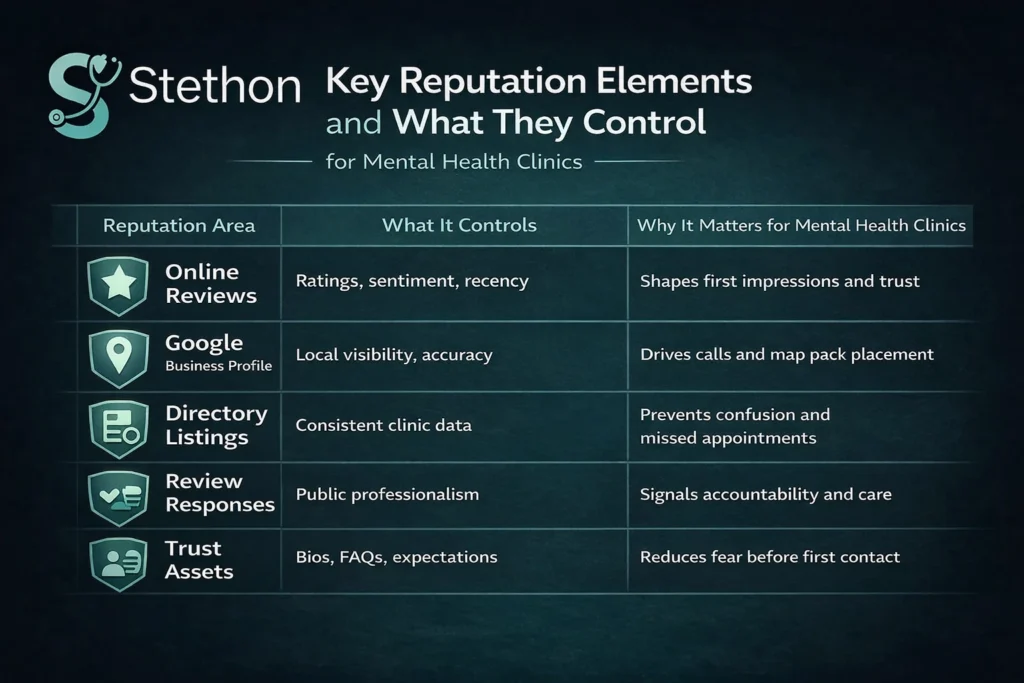
Reputation management is not one tactic. It is a system.
Additionally, you can run Google ads for your mental health clinic to secure the top rankings on your money terms.
Key reputation elements and what they control
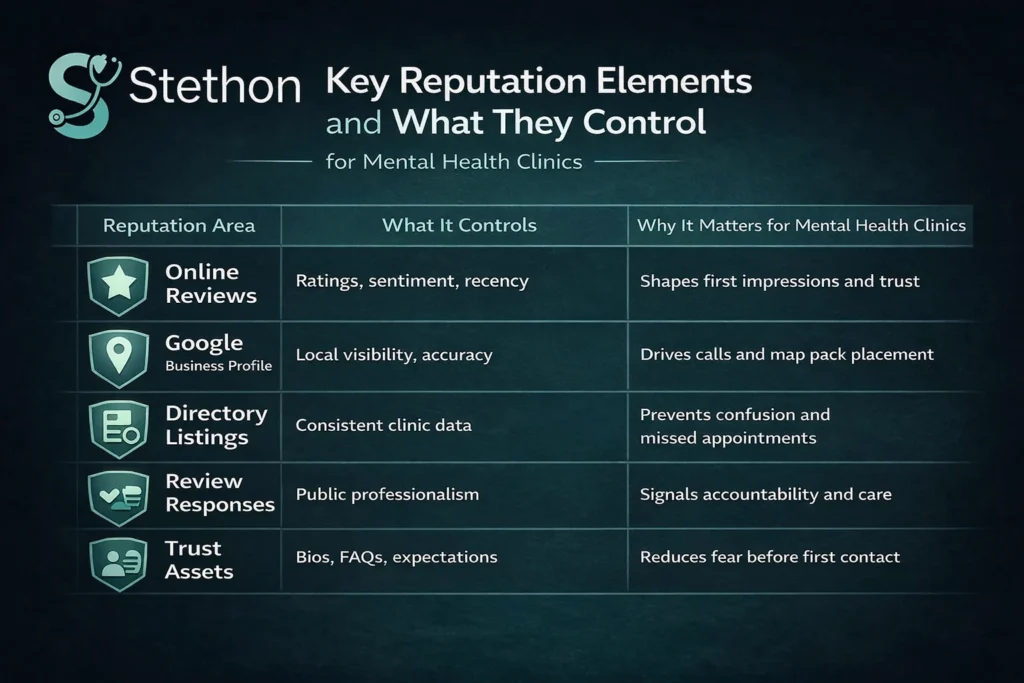
| Reputation Area | What It Controls | Why It Matters for Mental Health Clinics |
|---|---|---|
| Online Reviews | Ratings, sentiment, recency | Shapes first impressions and trust |
| Google Business Profile | Local visibility, accuracy | Drives calls and map pack placement |
| Directory Listings | Consistent clinic data | Prevents confusion and missed appointments |
| Review Responses | Public professionalism | Signals accountability and care |
| Trust Assets | Bios, FAQs, expectations | Reduces fear before first contact |
Mental health clinics reputation management works when these elements are aligned and maintained consistently.
The platforms that shape mental health clinic reputation
Reputation is distributed. Patients do not rely on a single website.
The most influential platforms typically include:
- Google Reviews and Google Maps
- Google Business Profile
- Psychology Today (especially for clinicians)
- Healthgrades and similar healthcare directories
- Zocdoc and appointment platforms
- Facebook and Yelp (market dependent)
Search engines cross-reference these sources. Inconsistencies weaken trust. Consistency strengthens both perception and local SEO.
Google Business Profile as a reputation hub
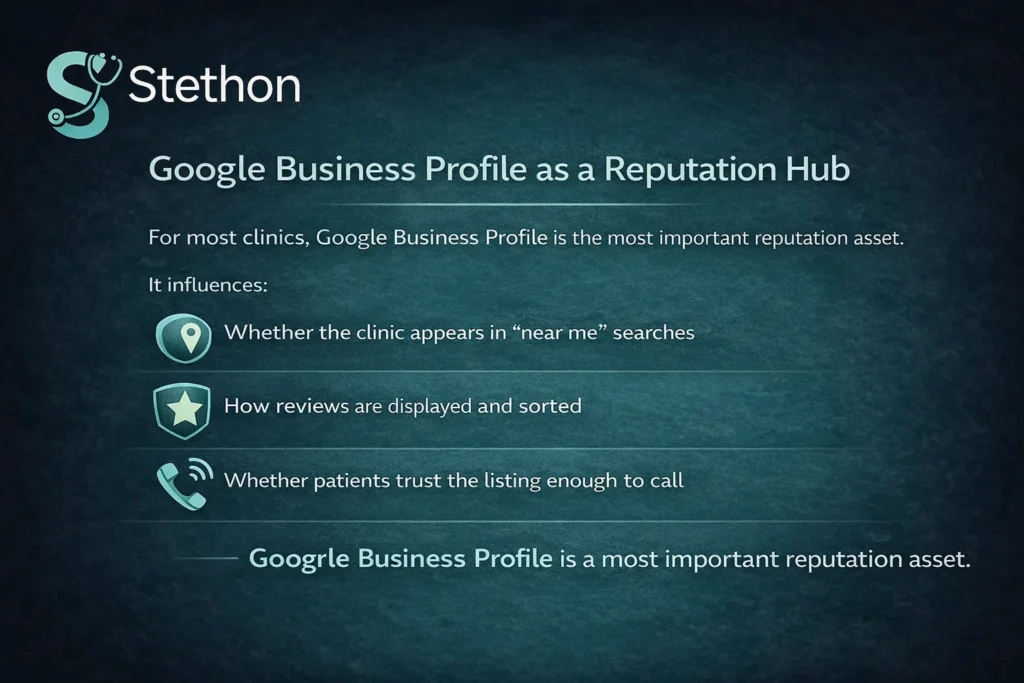
For most clinics, Google Business Profile is the most important reputation asset.
It influences:
- Whether the clinic appears in “near me” searches
- How reviews are displayed and sorted
- Whether patients trust the listing enough to call
Accurate hours, correct phone numbers, proper categories, listed services, and timely responses all contribute to stronger visibility and fewer negative experiences.
From a reputation standpoint, Google Business Profile reduces friction. From a marketing standpoint, it increases qualified patient inquiries.
Review velocity matters more than perfect reviews
Many clinics fixate on avoiding negative reviews. The more effective focus is review velocity.
Review velocity refers to how consistently new reviews are earned over time. Clinics with recent, steady reviews appear active and reliable. Clinics with old reviews appear disengaged, even if the ratings are high.
A clinic with one negative review and many recent positive reviews looks normal. A clinic with one negative review and no recent positives looks risky.
Reputation management for mental health clinics prioritizes momentum, not perfection.
How to collect reviews ethically in mental health settings
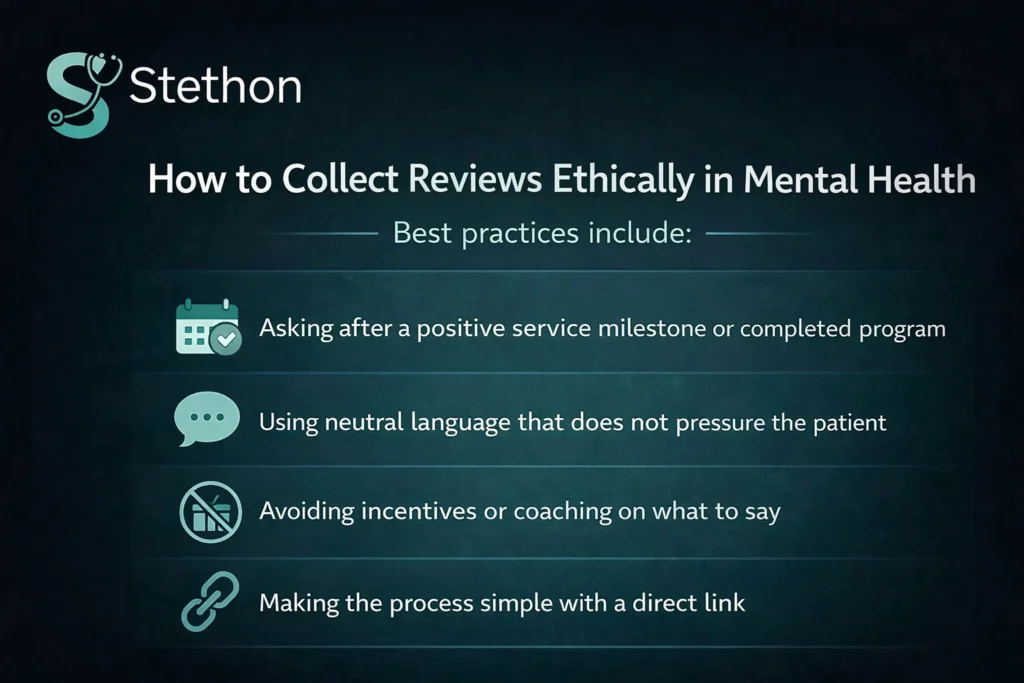
Mental health clinics must be careful when requesting reviews. The process should always be respectful, optional, and privacy-conscious.
Best practices include:
- Asking after a positive service milestone or completed program
- Using neutral language that does not pressure the patient
- Avoiding incentives or coaching on what to say
- Making the process simple with a direct link
Many clinics use private feedback forms or post-session prompts to invite responses. When implemented correctly, these systems improve review volume while protecting professional ethics.
How to respond to reviews without violating privacy
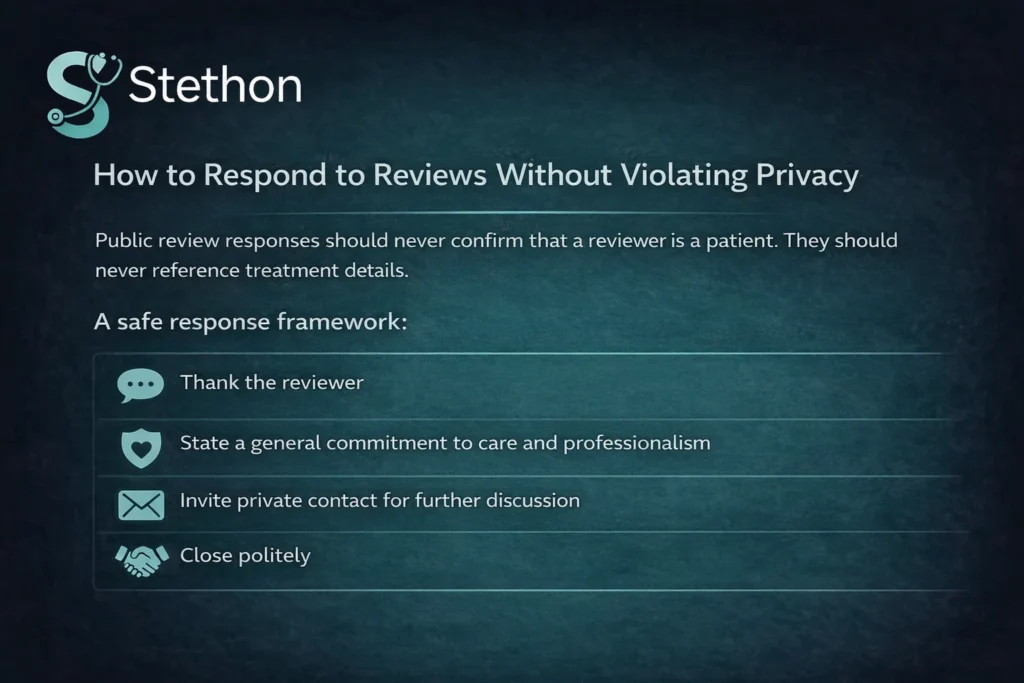
Public review responses should never confirm that a reviewer is a patient. They should never reference treatment details.
A safe response framework:
- Thank the reviewer
- State a general commitment to care and professionalism
- Invite private contact for further discussion
- Close politely
This approach protects confidentiality while showing future readers that the clinic is attentive and accountable.
Reputation management for mental health professionals and clinics requires discipline. Less detail is safer and more credible.
Related article: TikTok Ads for Mental Health Clinics
Listings consistency prevents invisible reputation damage
Many reputation problems never show up as complaints. They show up as frustration.
Wrong hours, duplicate listings, outdated phone numbers, or inconsistent clinic names create dead ends. Dead ends lead to missed calls, missed appointments, and eventually negative reviews.
Maintaining consistent NAP data (name, address, phone) across directories is a foundational reputation strategy. It reduces friction before it becomes feedback.
For this reason, running other advertising channels is usually a great choice, specially meta ads for mental health professionals who want more calls and booked appointments.
Reputation management for mental health professionals vs clinics
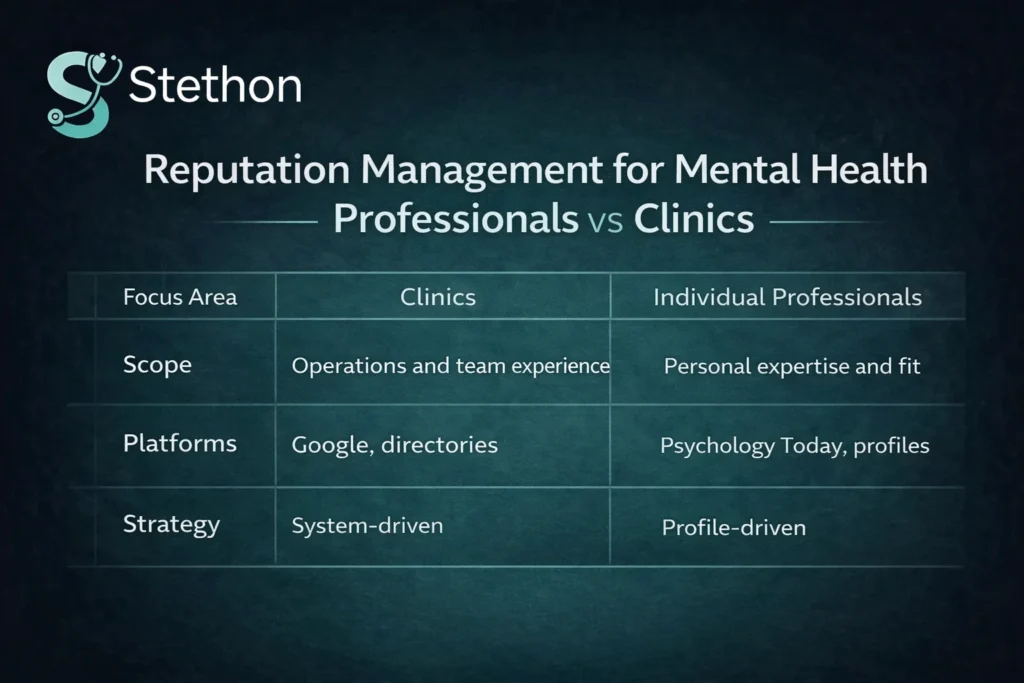
Reputation management for mental health professionals focuses more on individual positioning, credentials, and directory profiles. Clinics manage broader operational factors including staff experience, scheduling, and location consistency.
| Focus Area | Clinics | Individual Professionals |
|---|---|---|
| Scope | Operations and team experience | Personal expertise and fit |
| Platforms | Google, directories | Psychology Today, profiles |
| Strategy | System-driven | Profile-driven |
Both approaches share the same goal: helping the right patient feel confident enough to take the next step.
30-Day Reputation Management Checklist for Psychiatrists
| Timeframe | Action Item | What to Do | Why It Matters |
|---|---|---|---|
| Days 1–3 | Audit Google Business Profile | Verify hours, phone number, address, categories, and appointment link | Prevents patient confusion and missed calls |
| Days 1–3 | Review current Google reviews | Note rating, recency, response gaps, and recurring themes | Establishes baseline reputation health |
| Days 4–6 | Check directory listings | Confirm accuracy on Psychology Today, Healthgrades, Zocdoc, and major directories | Supports trust and local visibility |
| Days 4–6 | Remove or merge duplicates | Identify duplicate Google or directory profiles and request cleanup | Prevents split reviews and ranking dilution |
| Days 7–9 | Create a review request message | Write one neutral, privacy-safe review request | Ensures ethical and consistent outreach |
| Days 7–9 | Define review timing | Choose milestones (intake completion, program milestone, discharge) | Increases response rate without pressure |
| Days 10–12 | Set up feedback routing | Use a private feedback form before public review requests (optional) | Captures concerns before they go public |
| Days 10–12 | Draft response templates | Create approved replies for positive and negative reviews | Protects confidentiality and tone |
| Days 13–15 | Train admin or front desk | Align staff on when and how reviews are requested | Prevents inconsistent or risky asks |
| Days 16–18 | Optimize psychiatrist bio | Update credentials, specialties, populations served, and approach | Improves fit and reduces mismatched expectations |
| Days 16–18 | Publish “What to Expect” page | Explain intake, sessions, policies, and communication timelines | Reduces anxiety-driven complaints |
| Days 19–21 | Set up review alerts | Enable notifications for new Google and directory reviews | Allows timely, calm responses |
| Days 22–24 | Respond to all existing reviews | Apply privacy-safe response framework consistently | Signals professionalism to new patients |
| Days 25–27 | Analyze feedback patterns | Identify operational issues (access, wait times, billing clarity) | Turns reviews into process improvements |
| Days 28–30 | Document a monthly SOP | Write a simple monthly checklist for reviews and listings | Makes reputation management repeatable |
| Ongoing | Track review velocity | Aim for steady monthly review activity | Builds long-term trust and local rankings |
We can do it for you: Visit Our Mental Health Marketing Agency
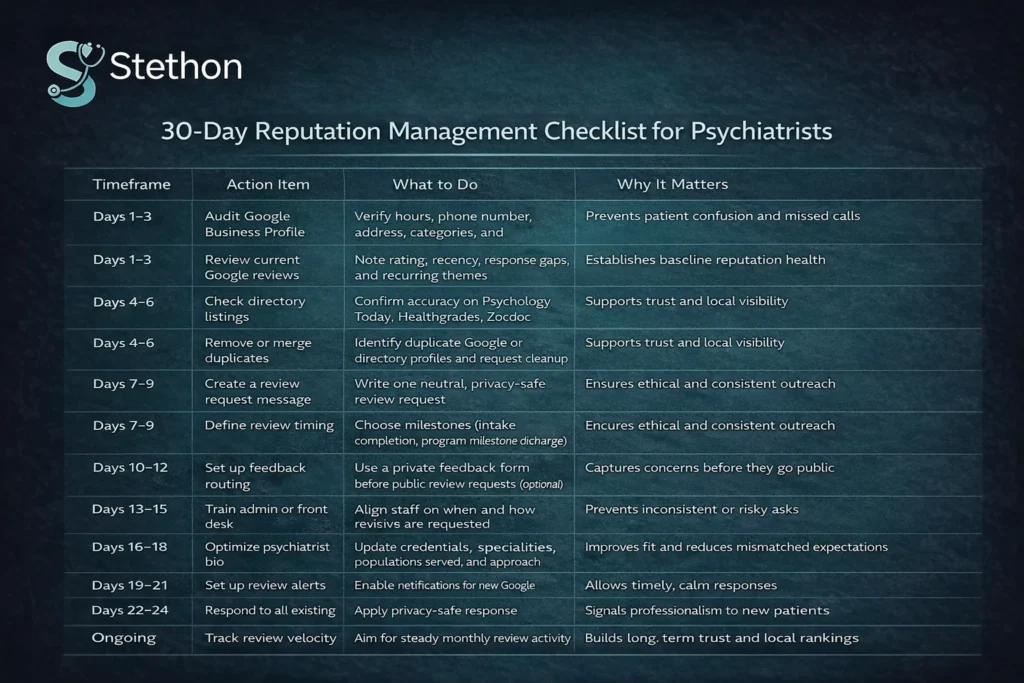
How to use this checklist
This checklist works best when treated as a system, not a one-time task. After the first 30 days, most psychiatrists move into a light monthly rhythm focused on review velocity, listing accuracy, and calm response consistency.
Why reputation management supports long-term growth for psychiatrists and psychologists
Reputation is not a quick fix. It compounds.
Clinics with strong reputations:
- Convert more website visitors into calls
- Rank more consistently in local search
- Experience fewer reputation crises
- Build stronger referral confidence
Reputation management for mental health clinics acts as infrastructure. When it is stable, every other marketing channel performs better in healthcare lead generation.
Takeaways from the top reputation management strategies for behavioral health clinics in 2026
Mental health clinics do not need aggressive marketing. They need clarity, consistency, and trust.
Reputation management works when it reflects the quality of care already being delivered. When reviews are current, listings are accurate, and responses are professional, patients feel safer reaching out.
That sense of safety is the real conversion driver.
What is reputation management for mental health clinics?
Reputation management for mental health clinics is the process of managing reviews, listings, and public feedback to build trust, protect privacy, and improve local visibility.
Can mental health clinics pay patients for reviews?
No. Paying for reviews or offering incentives violates platform policies and professional ethics. Reviews should always be voluntary and authentic.
Is it ethical for psychiatrists to ask patients for reviews?
Yes, psychiatrists can ethically request reviews if the request is optional, neutral, and does not pressure patients or influence what they say.
Does reputation management improve Google rankings for mental health clinics?
Yes, consistent reviews, accurate Google Business Profiles, and listing consistency support stronger local rankings and map pack visibility.
What platforms matter most for mental health reputation management?
Google Business Profile and Google Reviews matter most, followed by healthcare directories and professional profiles like Psychology Today.
Read More Healthcare Marketing Articles