AI for Healthcare Lead Generation and SEO: The 2026 Operator’s Framework
How does AI SEO generate healthcare leads?
AI search becomes a patient pipeline when Google AI Overviews, ChatGPT Search and Perplexity cite your clinic. Run AI SEO for healthcare lead generation like paid search, with a measured cost per booked appointment.
Table of Contents
Key takeaways
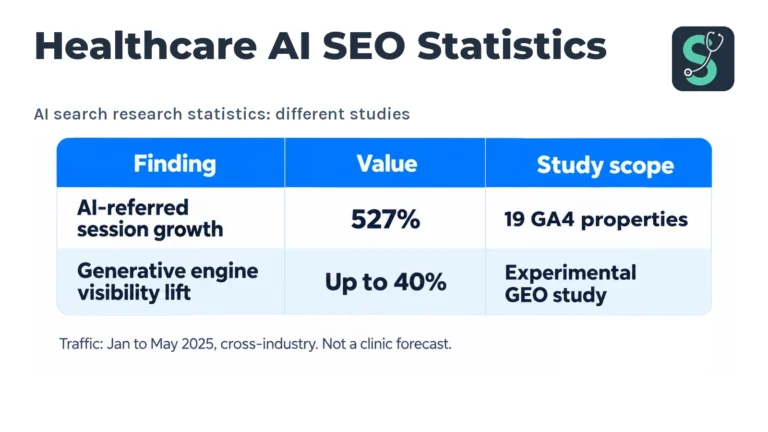
- AI-referred sessions grew 527% from January to May 2025 across 19 GA4 properties (cross-industry, not healthcare-only; Previsible, via Search Engine Land).
- Princeton’s GEO research (KDD 2024): adding quotations, statistics and cited sources raised visibility in generative engine responses by up to 40%, the highest-impact content change a clinic can ship.
- Brand mentions correlate more strongly than backlinks with AI Overview visibility (Ahrefs, 2025), so citation-heavy PR beats link building.
- A mid-sized clinic site can be AI SEO ready in 7 days. The constraint is priority, not cost or technical complexity.
AI SEO is a lead-generation channel, not a visibility play
A large share of US healthcare searches now resolve inside an AI answer, and patients who click through arrive pre-qualified, often after the AI named your clinic. Only a small minority of domains are cited by both ChatGPT and Google AI Overviews for the same query, so citation slots are scarce and defensible: clinics that win them compound, while the rest lose top-of-funnel traffic to zero-click answers.
The 6 AI SEO signals that drive healthcare lead generation
Princeton’s GEO research, Ahrefs’ brand-mention studies and the engines’ own citation patterns point to six signals, ranked by impact on lead generation.
- 1. FAQPage schema. Makes question-and-answer content explicit to machines on the YMYL pages engines scrutinize most. Princeton did not test FAQ markup, so it is an eligibility measure, not a measured citation lift. Add it to every service page and post via your SEO plugin, not hand-coded.
- 2. Passage length of 134-167 words. AI engines extract passages, not pages, and paragraphs in that window are far more likely to be quoted. Rewrite clinical service descriptions into citation-sized chunks.
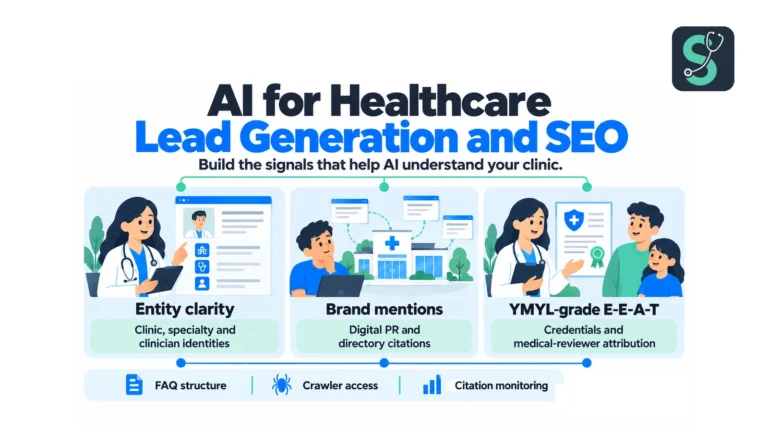
- 3. Entity clarity. Organization schema with sameAs links to your NPI record, state board listing and Google Business Profile tells engines exactly who you are; Person schema does the same for clinicians.
- 4. Brand mentions beat backlinks. Per Ahrefs, branded web mentions correlate more strongly with AI Overview visibility (0.664) than backlinks (0.218). Digital PR, podcasts, directory citations and local news are now the dominant authority signal.
- 5. YMYL-grade E-E-A-T. Engines penalize health content without verifiable expertise. Use credentialed author bylines, clinic address and hours, license references and medical-reviewer attribution.
- 6. Crawler allowlist and llms.txt. If robots.txt blocks GPTBot, OAI-SearchBot, ClaudeBot or PerplexityBot, nothing above matters. A correctly configured llms.txt signals which pages you want cited.
AI time-saving workflows for healthcare SEO titles and keywords
The fastest win is the brief, not the article. AI cuts a 4-hour keyword cluster map to about 20 minutes, with better output:
- 1. Give the AI the specialty, city, procedure and booked-patient revenue.
- 2. Ask for 30 commercial-intent queries grouped by funnel stage (awareness, consideration, booking).
- 3. Generate 10 title candidates per priority query, each under 60 characters and naming the specialty or procedure.
- 4. Edit every title for compliance: no outcome guarantees, treatment promises or superlatives that imply clinical results.
Title patterns that pass compliance and earn clicks: “[Specialty] in [City]: [the patient’s real question in five words],” “[Procedure] for [Condition]: what/when/how framing,” “[Condition] Near Me: [the practical decision the patient faces],” “[Specialty] vs [Alternative]: when to choose which.” With clinical review, they save 6 to 10 hours per cluster.
Best practices for AI SEO on healthcare websites: the 7-item floor
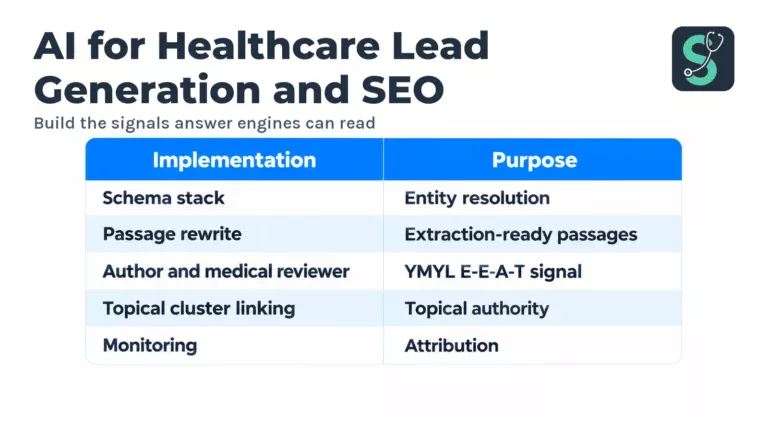
| # | Implementation item | What it does |
|---|---|---|
| 1 | Schema stack: Article + MedicalWebPage on clinical pages, FAQPage on services and posts, Organization with full sameAs chain | Entity resolution + citation eligibility |
| 2 | Passage rewrite: hero paragraphs and answer blocks into the 134-167 word window | Extraction-ready passages |
| 3 | llms.txt published at the site root | Declares canonical citation pages |
| 4 | Crawler allowlist: GPTBot, OAI-SearchBot, ClaudeBot, PerplexityBot, Google-Extended | The mechanical floor |
| 5 | Author + medical reviewer Person schema on every clinical page | YMYL E-E-A-T signal |
| 6 | Topical cluster linking: every cluster post links up to its pillar service page | Mechanical topical authority |
| 7 | Monitoring: GSC AI Overviews filter, AI referrer tracking, monthly citation audits | Attribution and competitive read |
How to measure AI SEO results in US healthcare
Most public AI SEO case studies report traffic lifts without attribution. For clinics, the metric that matters is booked appointments from AI-referred sessions. The measurement stack:
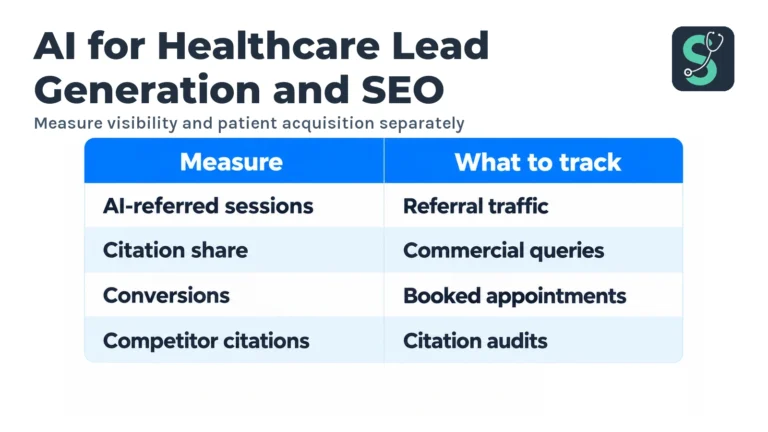
- Referrer tracking. GA4 filters for sessions from chat.openai.com, perplexity.ai and Copilot, tied to form submits, tracked calls and online bookings.
- GSC AI Overviews reporting. Pull monthly, split into commercial (booking-intent) and informational queries.
- Manual citation audits. Monthly, query your top 10 commercial keywords in ChatGPT, Perplexity and Google AI Overviews and record which clinics appear. It is the clearest competitive read available.
- Brand-search lift. If AI citations compound, branded searches grow, because patients remember the clinic the AI named.
Stethon Digital Marketing commentary: benchmark realistic citation share for the specialty and metro before work starts. With a baseline, AI SEO gets a cost per booked appointment like any other channel.
The 7-day AI SEO prep roadmap
| Day | Action |
|---|---|
| Day 1 | Audit schema; add Article + MedicalWebPage + FAQPage + Organization with sameAs |
| Day 2 | Rewrite hero passages on the top 10 pages into the 134-167 word window |
| Day 3 | Publish llms.txt; update the robots.txt crawler allowlist |
| Day 4 | Add author and medical-reviewer schema to all clinical pages |
| Day 5 | Map topical clusters; add internal links from every cluster post to its pillar service page |
| Day 6 | Configure GA4 AI-referrer tracking and the GSC AI Overviews filter; run the baseline citation audit |
| Day 7 | Ship one net-new cluster article targeting a commercial specialty + city query, built to all six signals |
FAQ
What is AI SEO for healthcare?
AI SEO for healthcare is the practice of structuring a clinic’s website, schema, content, and authority signals so AI engines (ChatGPT, Google AI Overviews, Perplexity, Bing Copilot) cite the clinic in their generated answers. The goal is booked appointments from AI-referred traffic, not general visibility.
How is AI SEO different from traditional SEO?
Traditional SEO optimizes for blue-link rankings and clicks. AI SEO optimizes for citation inside a generated answer, where passage length, entity clarity, brand mentions, and FAQ structure matter more than backlinks and meta tags. The disciplines overlap, but AI SEO rewards structured answers and entity authority over keyword density, and keyword stuffing actively hurts citation.
Does AI actually save time for healthcare content teams?
Yes, at the brief stage most of all: a 4-hour keyword cluster map compresses to about 20 minutes, and title generation improves with the right prompt patterns, provided every output passes clinical and compliance review before publication. The hours come back in planning, not in unedited publishing.
What AI SEO statistics should US healthcare operators track?
The pipeline numbers: AI-referred session growth (527% from January to May 2025 in Previsible’s cross-industry data), your citation share on your top 10 commercial queries across ChatGPT, Perplexity, and AI Overviews, AI-referred conversion events in GA4, and branded-search lift. Track them monthly against a specialty-and-metro baseline so wins are attributable.
How can I prepare my healthcare website for AI SEO?
Run the 7-day roadmap: schema stack, passage rewrites into the 134-167 word window, llms.txt, crawler allowlist, author and reviewer schema, topical cluster linking, and the measurement stack. Every step is executable in-house when the brief is clear; the constraint is priority.
Turn AI search into booked appointments
Stethon Digital Marketing runs AI search as a measured channel with a defined cost per booked appointment through the healthcare GEO program, integrated with the healthcare SEO program and the healthcare lead generation stack.
Editorial disclaimer
Produced by Stethon Digital Marketing (healthcare performance marketing). Updated October 2026.
Third-party figures are attributed to their publishers and reflect those studies’ own methods and dates; AI platform behavior changes quickly and citation dynamics shift with it. This guide is marketing guidance, not legal or medical advice, and not a guarantee of outcomes. Healthcare marketing workflows remain subject to HIPAA-related constraints; consult qualified compliance guidance for your clinic.

Stethon Digital Marketing Team
Healthcare SEO, PPC & Paid Social Specialists
Stethon Digital Marketing delivers SEO, PPC and social media advertising for independent healthcare practices across the United States. This guide draws on our hands-on campaign work and the primary sources cited throughout.