Best Ads for Pain Management Clinics: Examples & Patterns That Work in 2026
What are the best ads for pain management clinics?
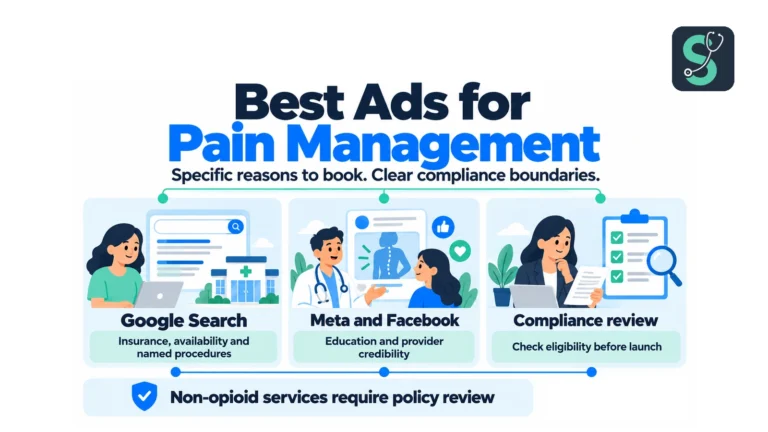
The best ads for pain management clinics lead with one verifiable reason to book this week (insurance accepted, same-week availability, a named non-opioid treatment) and pass Google and Meta compliance review before launch.
Table of Contents
Key takeaways
- Restricted, not banned: non-opioid pain management is restricted on Google and Meta; opioid prescribing is prohibited outside narrow exceptions (Stethon compliance runbook).
- No pain-specific benchmark exists; budget against the closest comparable specialty (table below).
- Specific beats vague: insurance, wait time or a named treatment outperforms “relief.”
- Regenerative framing is banned: strip PRP, stem cell and exosome claims from paid copy.
- Spend on Google and Meta: TikTok paid is closed to clinical pain services.
| Signal | Benchmark | Scope | Source |
|---|---|---|---|
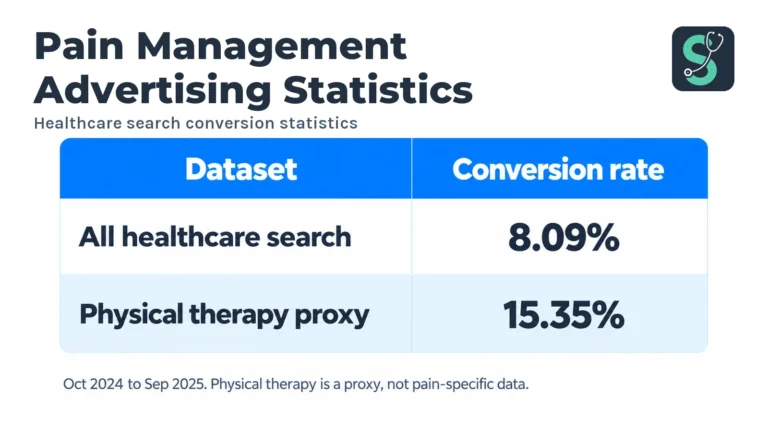
| Search CPC | $5.64 | Avg, all healthcare search | LocaliQ, healthcare search benchmarks (Oct 2024 to Sep 2025) |
| Search CVR | 8.09% | Avg, all healthcare search | LocaliQ (Oct 2024 to Sep 2025) |
| Search CPL | $66.02 | Avg, all healthcare search | LocaliQ (Oct 2024 to Sep 2025) |
| Physical therapy CPC/CVR/CPL | $4.95 / 15.35% / $32.79 | Closest published proxy specialty | LocaliQ (Oct 2024 to Sep 2025) |
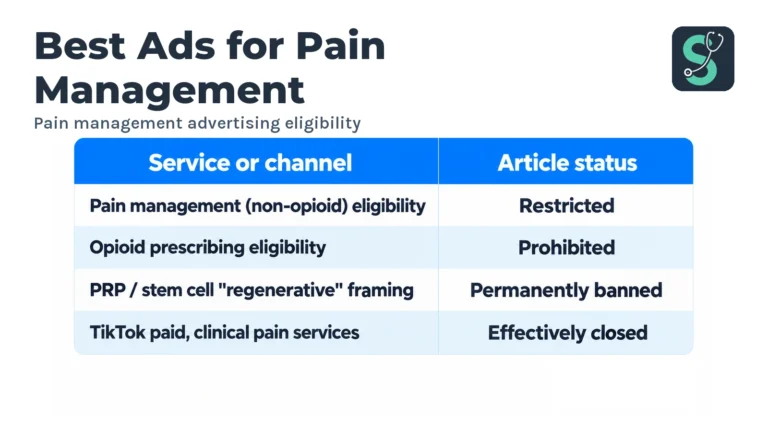
| Pain management (non-opioid) eligibility | Restricted | Google + Meta | Stethon compliance runbook |
| Opioid prescribing eligibility | Prohibited | Google + Meta | Stethon compliance runbook |
| PRP / stem cell “regenerative” framing | Permanently banned | Google + Meta paid | Stethon compliance runbook |
| TikTok paid, clinical pain services | Effectively closed | TikTok Ads | Stethon compliance runbook |
What Makes a Pain Management Ad Work in 2026
Chronic pain searchers have usually tried medication, chiropractic or PT before typing “pain management doctor near me.” The ad must remove the last objection: cost, wait time or whether you treat their condition.
The Stethon Take: name the exact treatment, wait time or insurance answer instead of promising relief. Searchers in pain trust falsifiable facts, not feelings.
Best Google Search Ad Patterns for Pain Management
Search carries the highest intent because searchers name their own problem. These six are templates from observed keyword and offer structures; localize and review for compliance before publishing.
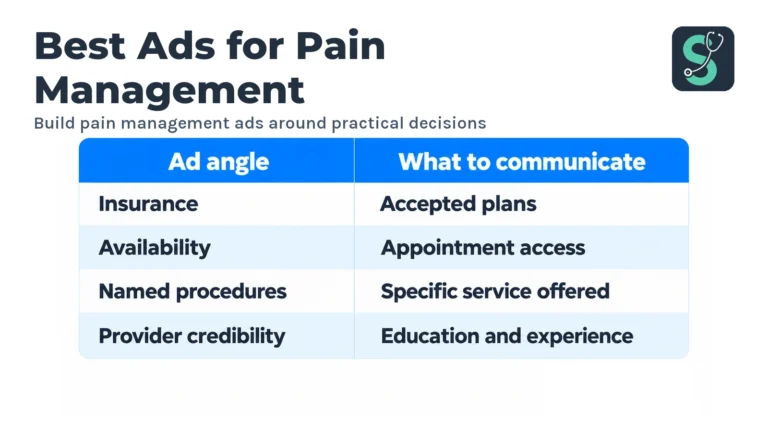
- 1. Insurance-first (Pattern). “Pain Doctor Who Takes Your Insurance.” Insurance verified before the first visit, same-week evaluation. Removes the biggest objection.
- 2. Named procedure (Pattern). “Epidural Steroid Injection, Board-Certified Pain Physicians,” on procedure keywords with direct booking. Converts two to three times better than a generic page.
- 3. Referral bypass (Pattern). “No Referral Needed, See a Pain Specialist This Week.” Catches searchers who wrongly assume they need a referral.
- 4. Post-surgical and work comp (Pattern). “Pain After Surgery Not Improving? Interventional Options Available.” High intent, active case management.
- 5. Second opinion (Pattern). “Second Opinion on Your Pain Treatment Plan,” with chart review plus consult. Dissatisfied patients are high value.
- 6. Local Services Ads (Pattern). Google Guaranteed badge and verified reviews above search ads, pay-per-lead on screened calls.
Best Meta and Facebook Ad Examples for Pain Management
Meta reaches pain patients months before they search, so creative educates first. It is also where compliance errors happen: no retargeting, Customer Match or lookalikes from health-condition visitors. The two real advertisers below are included for verified channel presence only; no ad copy is attributed.
- 1. National Spine & Pain Centers (Real, channel only). Public Facebook and LinkedIn presence for an affiliated-physician network of roughly 120 US locations. Worth watching: marketing a network, not a single clinic.
- 2. Back Pain Centers of America (Real, channel only). Call-tracked TV, Facebook and YouTube campaigns tracked via iSpot.tv. A tracked number signals top-of-funnel investment.
- 3. Education-first video (Pattern). “What Actually Happens During a Nerve Block? (60 Seconds),” linking to a condition page with a soft consult CTA.
- 4. Conservative-care checkpoint (Pattern). Carousel: “Still in Pain After Physical Therapy?” with a free history review. Targets patients past the step insurers require first.
- 5. Life activity (Pattern). Name the specific activity they miss; patients respond to what they lost, not a treatment name.
- 6. Credibility proof (Pattern). “Board-Certified. Fellowship-Trained. In-Network With Your Insurer.” Lowers perceived click risk.
- 7. Compliant reactivation (Pattern). Broad interests only, no remarketing: “New Non-Opioid Options for Chronic Pain, Ask Your Provider.”
Other Channels: YouTube, Display, and Where Not to Spend
Three more channels round out the plan:
- 1. YouTube pre-roll (Pattern). “Why Most Back Pain Does Not Need Surgery,” linking to a condition hub. Builds trust before search.
- 2. Contextual display (Pattern). “Board-Certified Pain Specialists Near You,” contextual targeting only, since health-visitor remarketing isn’t allowed.
- 3. LSA review proof (Pattern). Google Screened badge and review count, pay-per-lead: the lowest-risk paid unit in the category.
The Compliance Wedge Most Agencies Skip
Non-opioid pain management is restricted on Google and Meta: high scrutiny and narrow claims, not a block. Opioid prescribing is prohibited outside narrow public-health exceptions, and “regenerative” PRP, stem cell and exosome therapy is permanently banned on both (Stethon compliance runbook). The rules:
- No “cure” or guaranteed-relief claims anywhere in the ad or hero.
- No before/after imagery for any pain or spine procedure.
- No symptom-quiz lead forms framed as a “free assessment”; they trigger Meta’s Personal Health Detail restriction and the HIPAA Marketing Rule, and are the most common mistake we see.
- No Customer Match or lookalikes from health-condition visitors on Google or Meta.
- No TikTok paid for clinical pain services; there is no certification path, and any agency pitching it is courting a suspension. Organic is fine.
The Stethon Take: treat compliance as a creative constraint from the first draft, not a launch-day checklist. Pain management carries more permanently banned claims than almost any vertical we run.
The Stethon Way: every headline, claim and audience setting is checked against the restricted and prohibited lists before spend starts, as part of our healthcare PPC program.
What we won’t do: guaranteed-relief or “cure your chronic pain” claims, even on request. No agency controls a clinical outcome.
FAQ
Can pain management clinics run ads on Google and Meta in 2026?
Yes, with restrictions. Non-opioid pain management is restricted (higher scrutiny, narrower claims) and opioid prescribing is prohibited outright, with only narrow public-health exceptions (Stethon compliance runbook). PRP, stem cell, and exosome “regenerative” framing cannot advertise on paid platforms at all.
What is a realistic cost per lead for pain management ads?
No pain-management-specific benchmark is published. The closest figures: healthcare average $66.02 cost per lead at 8.09% conversion and $5.64 CPC (LocaliQ, data October 2024 to September 2025), and physical therapy at $32.79 per lead. Pain management typically lands between the two.
Why can’t pain clinics use symptom-quiz lead forms?
A “which treatment fits you” quiz collects health information before a real consult, triggering the Meta Personal Health Detail restriction and the HIPAA Marketing Rule, not just an ad-policy flag (Stethon compliance runbook). Agencies borrow the format from lead gen without checking it functions as PHI collection.
Is TikTok worth trying for pain management marketing?
Not for paid. TikTok’s ad policy blanket-bans paid campaigns for clinical pain and interventional treatment services, with no certification path to lift the ban (Stethon compliance runbook). Organic content remains open as a top-of-funnel channel.
What is the single biggest advertising mistake pain clinics make?
Advertising a guaranteed or cure-level outcome. Chronic pain has no guaranteed clinical outcome; both platforms treat guaranteed-relief language as a policy risk, and patients treat it as a red flag. A specific, falsifiable fact, insurance accepted or same-week booking, consistently outperforms it.
Ready to Run Compliant Pain Management Ads?
Pain management ads that convert pair a specific, falsifiable hook with a compliance review before launch. Stethon runs healthcare Google Ads and Meta campaigns with that audit built in, alongside dedicated pain management marketing and pain management PPC.
Editorial disclaimer
Produced by Stethon Digital Marketing (healthcare performance marketing). Updated October 2026.
This guide is an editorial synthesis of Stethon Digital Marketing’s compliance research and observed advertising patterns in the pain management category. It is not medical or legal advice, and it does not guarantee ad approval, campaign performance, or patient outcomes. Confirm current platform policy and consult compliance counsel before launching healthcare advertising.

Stethon Digital Marketing Team
Healthcare SEO, PPC & Paid Social Specialists
Stethon Digital Marketing delivers SEO, PPC and social media advertising for independent healthcare practices across the United States. This guide draws on our hands-on campaign work and the primary sources cited throughout.