How Healthcare Marketing Agencies Handle HIPAA, Privacy & Compliance
How do healthcare marketing agencies handle HIPAA compliance?
Healthcare marketing agencies handle HIPAA compliance by treating every form field, tracking pixel and ad setting as a possible PHI exposure: BAA-covered vendors for patient data, specialty-specific ad rules, and forms that never pair identity with health details.

Table of Contents
Key takeaways
- Mental health is not a Meta Special Ad Category; applying one cripples targeting for no compliance benefit.
- Meta does not name senior living; we run residence ads under Housing.
- TikTok bans all paid telehealth and mental health/therapy ads, with no certification path.
- A “free assessment” symptom-quiz lead form violates Meta’s Personal Health Detail policy and creates HIPAA Marketing Rule exposure.
- LegitScript Healthcare Merchant certification ($975 application plus $2,150/year per website, as of October 2026) is a real prerequisite for several ad categories.
Paid ad eligibility by specialty: a quick-reference excerpt
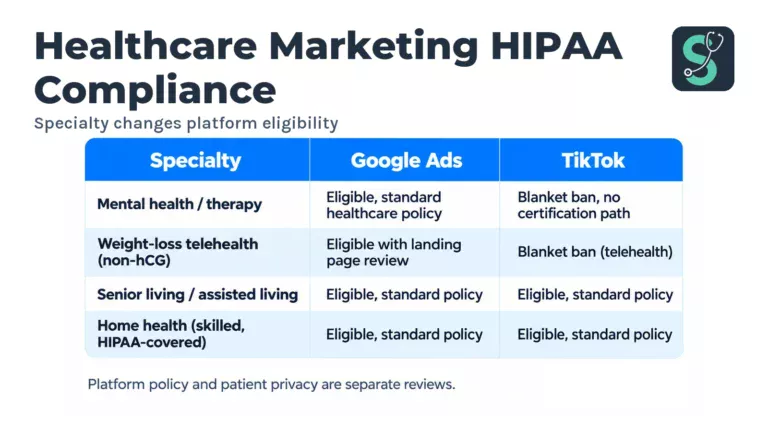
Stethon keeps an internal 38-vertical paid-ad eligibility matrix (last verified 2026-05-06). Four rows show how differently the same three platforms treat adjacent specialties.
| Specialty | Google Ads | Meta | TikTok |
|---|---|---|---|
| Mental health / therapy | Eligible, standard healthcare policy | Eligible, NOT a Special Ad Category | Blanket ban, no certification path |
| Weight-loss telehealth (non-hCG) | Eligible with landing page review | Eligible; hCG-based offers are permanently banned | Blanket ban (telehealth) |
| Senior living / assisted living | Eligible, standard policy | Eligible; we select Housing SAC when the ad markets a residence (Meta does not name senior living) | Eligible, standard policy |
| Home health (skilled, HIPAA-covered) | Eligible, standard policy | Eligible, standard policy | Eligible, standard policy |
What counts as PHI in a marketing context
A practice is a HIPAA covered entity; an agency handling its patient data, forms or ad accounts is generally a business associate. Data becomes PHI once an identifier sits next to health information, so it shows up far from the chart: a form asking what condition you want treated, a call transcript mentioning a diagnosis, a CRM record pairing a name with an appointment type, or a conversion event fired by a psychiatry booking.
The Stethon Take: the real question is whether any system in a campaign combines an identifier with a health detail. A “book a cleaning” dental ad rarely touches PHI; a “free anxiety-friendly sedation dentistry consult” ad almost certainly does once someone clicks and self-identifies.
Our pre-launch filter: if any funnel system (ad platform, landing page, form, CRM, call tracker) receives an identifier (name, phone, email, IP-linked cookie) paired with a health detail (condition, treatment sought, appointment type), it needs a BAA or a redesign that removes the pairing before data leaves the practice’s covered environment.
Tracking and analytics: GA4, Meta Pixel, and the honest state of the industry
HHS names no “HIPAA-safe” analytics vendors or configurations. The Security Rule’s general requirements (access controls, encryption, audit logging, a signed BAA with any vendor handling PHI) apply to tools not built for healthcare. Default GA4 and Meta Pixel are not HIPAA-compliant, and neither Google nor Meta signs a BAA for standard implementations.
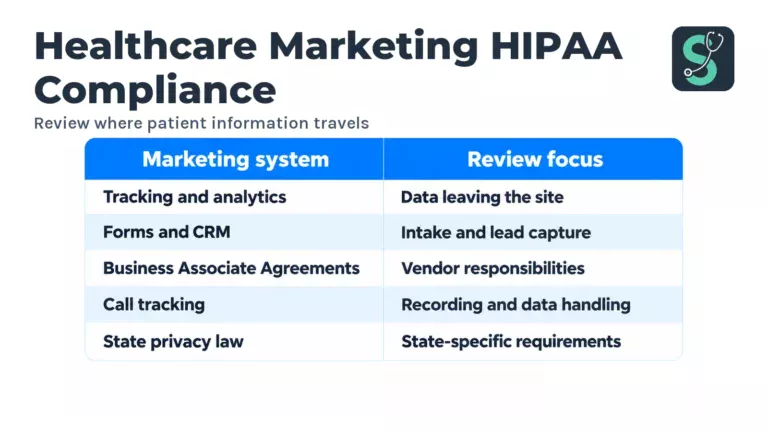
Stethon’s operating approach, built from Security Rule principles and platform documentation:
- Strip identifiers before they reach the pixel or tag. No names, emails, phone numbers or condition-revealing URL paths (“/schedule-oncology-consult/” leaks a health detail through the referrer even without a name).
- Fire conversions on generic actions. “Form submitted” and “call started” are safe. “Depression screener completed” is not, on any platform.
- Prefer server-side tagging with a stripping layer. Meta’s Conversions API and server-side GA4 control exactly which fields transmit, instead of trusting a browser script not to leak a URL parameter or form value.
- Any tool touching patient-identifiable data needs a BAA. No BAA, no access to forms, call trackers or CRM fields that can carry PHI. De-identified aggregate analytics (page views, sessions, non-health conversions) need none.
The Stethon Take: “we use Google Analytics, it’s fine” is the most common false comfort we hear from clients switching agencies. The exposure is what a previous agency configured GA4 to capture, so we audit event parameters and URL structures on every new account before touching creative or keywords.
Forms, lead capture, and CRM integrations
A symptom quiz (“which of these symptoms are you experiencing?”) before a consult booking is a health questionnaire collected outside a clinical encounter. Tied to contact details for follow-up, it triggers the HIPAA Marketing Rule on top of Meta’s Personal Health Detail limits on condition-specific lead forms.
The platform can reject the form, and the practice still owns the stored data’s HIPAA exposure. The fix: collect contact details plus a general service-line interest (“mental health services,” not “have you experienced suicidal ideation in the past two weeks”), and qualify clinically after intake, inside the practice’s workflow.
A CRM with any field pairing identity and health detail handles PHI and needs a signed BAA, role-based access for agency staff, and an audit trail. HubSpot, Salesforce and most major CRMs offer HIPAA-eligible tiers with a BAA; default plans usually are not covered. Checking which tier a client actually runs takes five minutes, and most agencies skip it.
The Stethon Way: before launch, we check form and CRM field mapping against one rule: no public form field combines an identifier with a specific condition, symptom or diagnosis. Service-line interest (“therapy,” “psychiatric medication management”) is fine.
Advertising platform rules: where most agencies get it wrong
The Special Ad Category myth. Meta’s Special Ad Categories cover financial products and services, employment, housing, and social issues, elections or politics. They fix ages at 18 to 65+, include all genders, and remove some demographic, behavior and interest options and Advantage+ lookalikes. Mental health, addiction treatment and most clinical specialties are not on the list, so toggling SAC for them loses targeting for zero compliance benefit. For senior-living residence ads, we select Housing.
Permanent bans, not gray areas. Google and Meta never allow paid ads for compounded peptides, NAD+ therapy, stem cell and exosome or PRP-as-regenerative-medicine claims, hCG for weight loss, ephedra, recreational cannabis, non-medical anabolic steroids, or prescription opioids. No certification or disclaimer changes this. Trying anyway gets accounts suspended, sometimes permanently, and the client loses the account history.
Framing traps. “Anti-aging,” “longevity,” “cure” or “guaranteed” language, before/after photos and symptom-quiz lead forms trip platform review even for fully legal services. “Look 10 years younger” gets a hormone clinic flagged as an anti-aging claim; “restore energy and metabolic health” does not.
Certification is real, not an upsell. LegitScript Healthcare Merchant certification ($975 application plus $2,150 per year per website, as of October 2026) is required for several Google and Meta ad categories. Other types, such as Internet Pharmacy and Addiction Treatment, have their own fees; check LegitScript’s pricing page. Plan for it at launch so ads aren’t blocked mid-campaign.
Targeting restrictions with no opt-out. Google and Meta both prohibit Customer Match uploads, lookalike or Advantage+ audiences built from health-condition website visitors, audience expansion, and remarketing keyed to health-condition search terms. No account rep can waive these.
TikTok is its own category. TikTok bans all paid telehealth and mental health or therapy ads, with no certification path. Organic content is unrestricted. That’s why telehealth brands running paid campaigns successfully (Hims/Hers, Ro, Sequence, Form, Midi Health, Evernow) use Google and Meta, not TikTok.
What we won’t do: start ad spend for a client offering a permanent-ban substance. We restructure the offer, drop that service line from paid promotion, or decline paid media and handle SEO only. Hoping the platform won’t notice is how clients lose their entire ad history overnight.
Business Associate Agreements: the fastest vetting question a practice can ask
A Business Associate Agreement is the HIPAA-required contract between a covered entity and any vendor that creates, receives, maintains or transmits PHI on its behalf. It binds the vendor to use and disclosure limits, Security Rule controls, breach notification within defined timelines, and cooperation with the practice’s compliance. An agency handling health-linked form submissions, call recordings or CRM records needs one signed before that data flows.
The question to ask: “Will you sign a BAA?” A healthcare-fluent agency has a standard BAA ready, knows which tools and subcontractors it covers, and can name which campaign systems (CRM, call tracker, form backend) fall inside or outside it. Hesitation, an unexplained “we don’t really touch patient data,” or never having been asked are red flags.
The Stethon Take: signing a BAA should change which tools enter the campaign stack. An agency that signs one and changes nothing filed the obligation without integrating it.
Call tracking, retargeting restrictions, and compliance audits
Call tracking. Dynamic number insertion and call recording become a PHI channel the moment a caller mentions a symptom, diagnosis or medication. The vendor needs a BAA if recordings or transcripts are stored, transcribed or analyzed, and those recordings need PHI-level access controls and retention limits, not the default 24-month setting.
Retargeting restrictions. Retargeting all site visitors is standard. An audience built from visitors to “/depression-treatment/” pairs a health detail with an identifier (their ad ID) and hands it to a platform. Google and Meta both prohibit condition-based retargeting, with no opt-out.
Compliance audits. Walk the full funnel: vendors touching data and their BAAs, what each form field captures, what each conversion event fires on, CRM retention, and access controls on call recordings. Platform policy changes quarterly, so re-run the audit whenever the funnel changes meaningfully, not just at kickoff.
The Stethon Way: every new account gets this audit before any ad goes live, including fixes for symptom-quiz or condition-specific retargeting setups inherited from a prior agency.
State privacy law variance
HIPAA is federal, but California, Washington and a growing list of states have health-data and consumer privacy laws that can add obligations, sometimes covering data HIPAA does not (Washington’s My Health My Data Act reaches beyond HIPAA’s covered-entity scope). These change by legislative session, so multi-state practices should confirm with counsel what applies in each state.
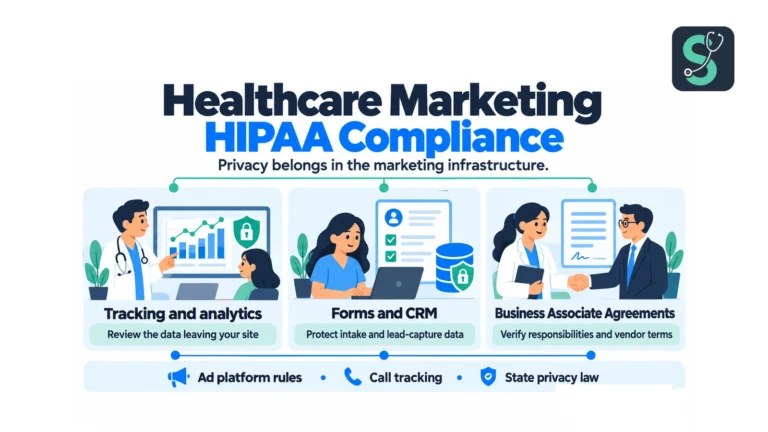
Work with an agency that treats compliance as infrastructure
Stethon’s healthcare SEO program and healthcare Google Ads program both run this funnel-level compliance audit before any deliverable ships, as part of the engagement rather than a separate line item.
FAQ
Is my healthcare marketing agency required to sign a HIPAA Business Associate Agreement?
Yes, if the agency’s workflow touches any system that creates, receives, maintains, or transmits PHI on the practice’s behalf, including forms, call tracking, or a CRM handling patient records. An agency that hesitates on this question or has never been asked has likely not audited its own workflow against HIPAA obligations.
Does Google Analytics or Meta Pixel violate HIPAA?
Neither tool is inherently a violation; the exposure comes from configuration. Standard GA4 and Meta Pixel implementations are not covered by a BAA from either company, so any event, URL parameter, or form field that pairs an identifier with a health detail creates risk. Aggregate, de-identified analytics without that pairing do not require a BAA.
Can mental health practices run Meta ads without hitting Special Ad Category restrictions?
Yes. Mental health is not one of Meta’s Special Ad Categories (financial products and services, employment, housing, social issues, elections or politics), so standard detailed targeting and lookalike audiences remain available. Senior living and assisted living work differently: Meta does not name them in its Special Ad Categories; when an ad markets a residence (a place to live), we select Housing, which restricts targeting.
What is the fastest way to vet a healthcare marketing agency’s compliance knowledge?
Ask directly whether they will sign a Business Associate Agreement and which specific tools in their stack it covers. A specialist agency answers immediately with a standard BAA ready for review. Vague answers or “we don’t really touch patient data” without explanation are the clearest red flag available in a single question.
Do state privacy laws add HIPAA-like obligations for healthcare marketing?
Often, yes. States including California and Washington have enacted health-data or general consumer privacy statutes that can extend beyond HIPAA’s scope, sometimes covering data HIPAA does not reach. Practices marketing across multiple states should confirm with qualified counsel whether their specific data flows trigger additional state-level obligations.
Editorial disclaimer
Produced by Stethon Digital Marketing (healthcare performance marketing). Updated October 2026.
This guide is marketing guidance based on publicly available platform policy, published certification pricing, and Stethon Digital Marketing’s operating practices. It is not legal advice, does not constitute a HIPAA risk assessment, and should not be treated as a substitute for review by qualified healthcare compliance counsel, particularly regarding state privacy law and any practice-specific BAA terms.

Stethon Digital Marketing Team
Healthcare SEO, PPC & Paid Social Specialists
Stethon Digital Marketing delivers SEO, PPC and social media advertising for independent healthcare practices across the United States. This guide draws on our hands-on campaign work and the primary sources cited throughout.