Boutique vs. Full-Service Healthcare Marketing Agencies: Which Delivery Model Fits Your Practice?
Boutique or full-service: which healthcare marketing agency is better?
Neither is better across the board: a boutique healthcare marketing agency fits most practices with 1 to 5 locations, while 10+ location groups and hospital systems need a full-service agency’s bench depth. Fit depends on location count, budget and internal marketing capacity.
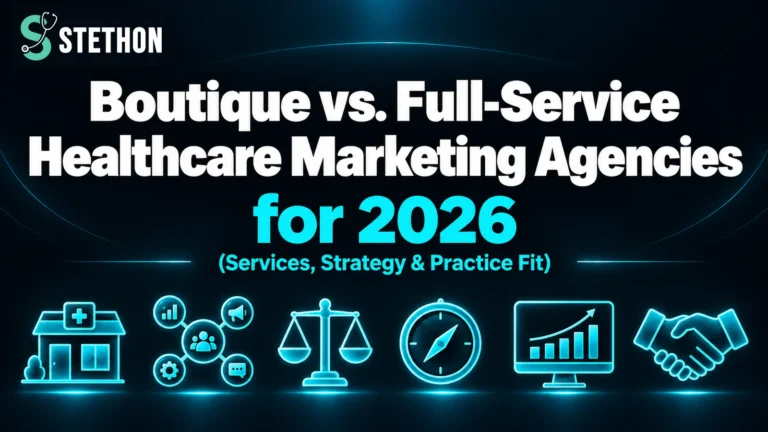
Table of Contents
Key takeaways
- Model over size: a single-location clinic and a 40-location hospital system need different vendor types, not just different budgets.
- Boutique healthcare-only: $750 to $5,000+/month; specialty focus and direct senior access, less bench depth.
- Full-service enterprise: often $7,500/month and up; built for scale problems boutiques can’t staff for.
- Freelancers and channel specialists: right for a narrow, defined scope; wrong for coordinated cross-channel strategy.
- Most common mismatch: a 3-location practice paying enterprise rates for a bench it never uses, or a 15-location group underpaying a boutique for depth it lacks.
Delivery model comparison at a glance
| Delivery model | Typical cost band | What you get | Best-fit practice |
|---|---|---|---|
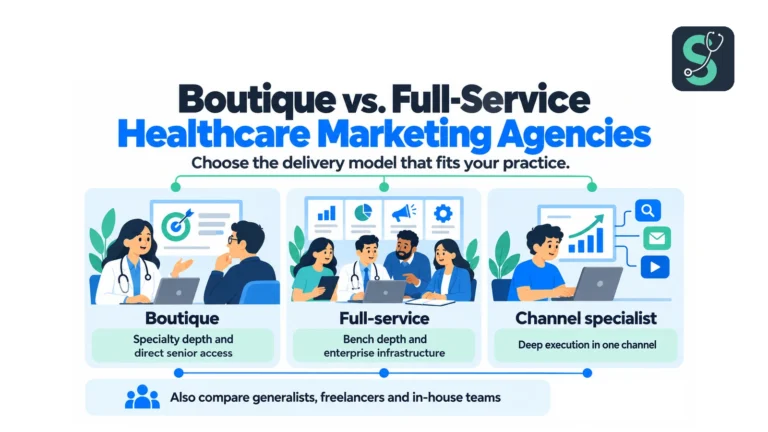
| Boutique healthcare-only agency | $750 – $5,000+/mo | Specialty depth, direct senior access, healthcare-specific compliance fluency | Single-location to 5-location independent practice |
| Full-service / enterprise healthcare agency | Roughly $7,500 – $25,000+/mo | Bench depth, dedicated account team, enterprise compliance and reporting infrastructure | DSOs, hospital systems, 10+ locations |
| Generalist marketing agency | Commonly $2,000 – $10,000/mo | Broad channel skill, standard marketing playbooks | Practices willing to train the agency on healthcare specifics |
| Freelancer / solo consultant | Roughly $500 – $3,000/mo or hourly project rates | Low overhead, one point of contact, flexible scope | Solo practitioner or narrowly scoped single-channel project |
| Channel-specialist shop | Commonly $1,000 – $5,000/mo per channel | Deep execution in one channel (SEO-only or PPC-only) | Practices with in-house strategy that need one channel executed well |
Boutique healthcare-only agencies: what the price actually buys
Boutique healthcare-only agencies are small, senior teams working mainly with clinics and healthcare groups, at $750 to $5,000+/month depending on scope.
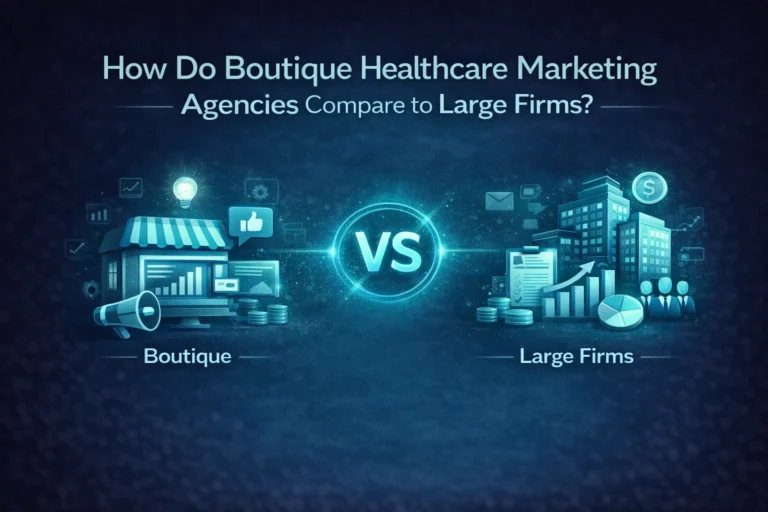
The team already knows HIPAA-adjacent constraints, Google and Meta healthcare ad policy, medical-review content standards and your vertical’s patient journey, so there is no discovery phase spent explaining a BAA, and senior staff are reachable directly. The limit is bench depth: a 6-to-12-person shop can’t run enterprise paid media, a 40-location content calendar and a custom hospital attribution build at once. Capacity, not competence, is the constraint.
The Stethon Take: specialization compounds. A healthcare-only agency learns from hundreds of clinic sites, ad accounts and compliance edge cases that a generalist touching healthcare once a year never sees. That is the product, not the retainer.
On a flat team, the person answering a compliance question during a Google Ads policy update often set up the account. Healthcare ad policy changes quickly and unevenly by specialty, and a stale answer can cost a week of paused ad spend.
Full-service and enterprise agencies: when a boutique is genuinely the wrong call
Full-service and enterprise agencies start around $7,500/month and run well past $25,000/month for hospital systems and large DSOs. That pays for dedicated account teams, in-house creative and video, reporting that rolls up dozens of locations, and staff who handle hospital procurement and legal processes.
The benefit is redundancy: if one specialist leaves, three more can cover. The cost is founder-level attention and speed, spread across dozens of accounts and layers of account management.
The Stethon Take: a 40-location hospital system needing procurement-compliant onboarding, legal review cycles and a bench that survives turnover should not hire a boutique, Stethon included; the mismatch shows up within a quarter as missed deadlines and overextended staff. The real risk is any agency taking accounts past its staffing capacity.
Generalist agencies and freelancers: the middle and the floor
Generalist agencies serve many industries at roughly $2,000 to $10,000/month. They bring broad channel competence, often strong creative or paid media from e-commerce, SaaS or local services, but not HIPAA-aware tooling, medical-review workflows or specialty ad-policy fluency by default. The practice pays for their months of healthcare learning in a slower ramp and avoidable compliance mistakes.
Freelancers and solo consultants cost roughly $500 to $3,000/month, or hourly per project: low overhead, direct communication and narrow scoping, good for a website rebuild or a content sprint. The catch is coverage: their vacation, illness or overload is your outage, they rarely carry larger shops’ certifications or compliance depth, and nobody double-checks their work.
The Stethon Way: Stethon sizes its Local SEO and Full SEO programs for solo practitioners and 2-location groups, who shouldn’t have to pick between a freelancer’s coverage risk and a generalist’s learning curve. Compare the ranges above before the first call; the call sets scope and fee.
Channel-specialist shops: depth in one lane, not the whole road
Channel-specialist shops do SEO-only or PPC-only work at roughly $1,000 to $5,000/month per channel, often with deeper execution than a full-stack agency’s generalist team. They lack coordinated strategy: a PPC-only shop can’t see whether organic content cannibalizes paid intent, and an SEO-only shop has no say in the landing pages a PPC vendor builds.
It fits practices with an internal marketing lead who needs execution in one channel; without that lead, nobody watches the seams between channels.
What we won’t do: guarantee #1 rankings. No agency controls Google’s algorithm, and a vendor promising a position is either lying or planning tactics that get YMYL healthcare sites penalized. Treat a ranking guarantee as an immediate disqualifier.
In-house hire: the sixth option, briefly
An in-house generalist marketer costs an illustrative $50,000 to $90,000/year plus benefits and tooling, more for a specialist. It buys full-time attention and institutional knowledge but gives up agency bench depth, platform relationships and the option to swap vendors.
How to actually decide
Match the model to location count and internal marketing capacity. 1 to 5 locations, no marketing staff: a boutique healthcare-only agency almost every time, since specialty depth outweighs bench depth at that scale. 10+ locations or a hospital system: full-service. An internal marketing lead with a narrow execution gap: a channel specialist. A small, defined test project: a freelancer. A generalist: only if the practice can pay for the healthcare learning curve or needs non-healthcare skills, like a large-scale brand campaign.
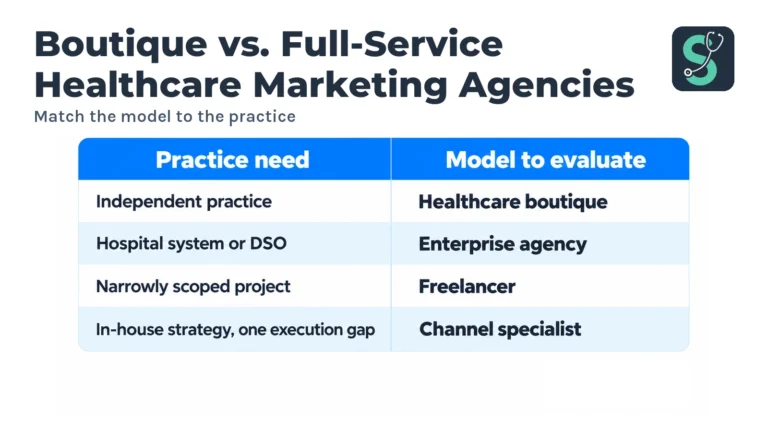
Budget alone sorts poorly. At $3,000/month, a single-location dermatology practice gets more from a boutique’s Full SEO program than from a generalist retainer, because specialty depth converts faster per dollar at that scale. A 12-location urgent care group at the same $3,000 is underfunded; it needs a larger retainer or a narrower initial scope, not a different vendor type.
FAQ
Is a boutique agency cheaper than a full-service agency?
Generally yes at the entry tiers. Boutique healthcare-only agencies commonly run $750 to $5,000+/month, while full-service and enterprise healthcare agencies generally start around $7,500/month and climb past $25,000/month for hospital-system scope. The gap reflects real cost structure, bench depth and enterprise reporting infrastructure, not just margin.
When does a practice outgrow a boutique agency?
Generally once a practice crosses roughly 8 to 10 locations, or takes on procurement and legal requirements typical of hospital-system contracts, a boutique agency’s staffing depth becomes the binding constraint. That’s a capacity ceiling, not a quality ceiling, and it’s worth naming directly before signing a renewal that no longer fits.
Should I hire a freelancer instead of an agency?
Only for a narrowly scoped, well-defined project, a website rebuild or a content sprint, where a single point of failure is an acceptable risk. For ongoing SEO, PPC, or multi-channel marketing, a freelancer’s lack of coverage during illness, vacation, or overload becomes the practice’s outage, which is why most ongoing engagements fit an agency model better.
What does a channel-specialist shop not cover that a full-stack agency does?
A channel-specialist shop, SEO-only or PPC-only, has no visibility into how its channel interacts with the others. It won’t catch a PPC landing page cannibalizing organic intent, or an SEO content calendar competing with paid campaigns for the same keywords. That coordination requires either an internal marketing lead or a full-stack vendor watching all channels together.
Does a generalist marketing agency need healthcare experience to be effective?
Not strictly, but it should be priced and scheduled as a learning curve. A generalist agency without prior healthcare experience needs onboarding time to understand HIPAA-adjacent marketing constraints, ad platform healthcare policy, and medical-review content standards, work a healthcare-specialist boutique already has running on day one.
Match the model to the practice, then check the number
Delivery model decides what’s possible; cost decides what’s sustainable. Check your model against real 2026 pricing, not a single quote, in Stethon’s breakdown of how much healthcare SEO costs in 2026.
Editorial disclaimer
Produced by Stethon Digital Marketing (healthcare performance marketing). Updated November 2026.
This article is marketing guidance, not legal or medical advice. Market price ranges reflect general industry norms as of 2026 and vary by market, scope, and vendor; Stethon’s own pricing is current as of publication. Consult qualified counsel for compliance-specific questions before signing any vendor contract.

Stethon Digital Marketing Team
Healthcare SEO, PPC & Paid Social Specialists
Stethon Digital Marketing delivers SEO, PPC and social media advertising for independent healthcare practices across the United States. This guide draws on our hands-on campaign work and the primary sources cited throughout.