How to Choose a Healthcare Marketing Agency: 12 Evaluation Criteria
How do you choose a healthcare marketing agency?
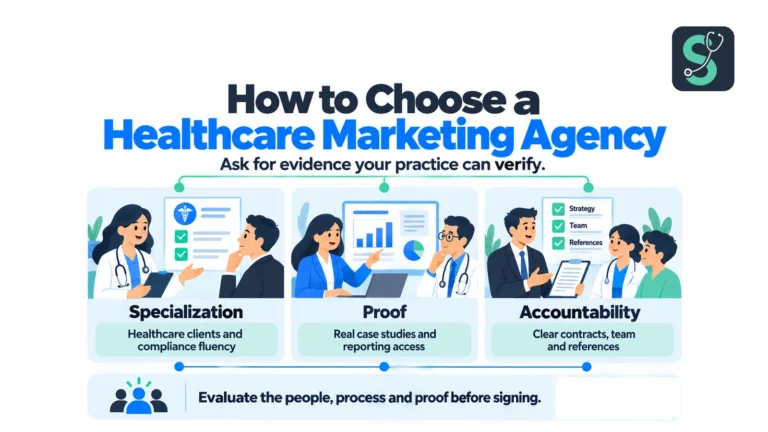
Choose a healthcare marketing agency by scoring it on 12 checkable criteria, from healthcare specialization and compliance fluency to verifiable case studies, transparent pricing and references you can call.
Table of Contents
Key takeaways
- Specialization beats size. Ask for healthcare-specific clients and results, not agency-wide proof.
- Compliance is testable in one question: will the agency sign a Business Associate Agreement (BAA) before patient data touches its tools? Hesitation is a red flag.
- Verify case studies. If an agency won’t connect you with the named client, treat its numbers as unconfirmed.
- Pricing clarity signals maturity. No range after two calls usually means pricing to your perceived budget, not the scope.
- Team structure is what you buy. Agency, freelancer and in-house hybrid are different risk profiles, and the invoice label doesn’t always match the website.
12 criteria at a glance
| # | Criterion | What to verify | Immediate disqualifier |
|---|---|---|---|
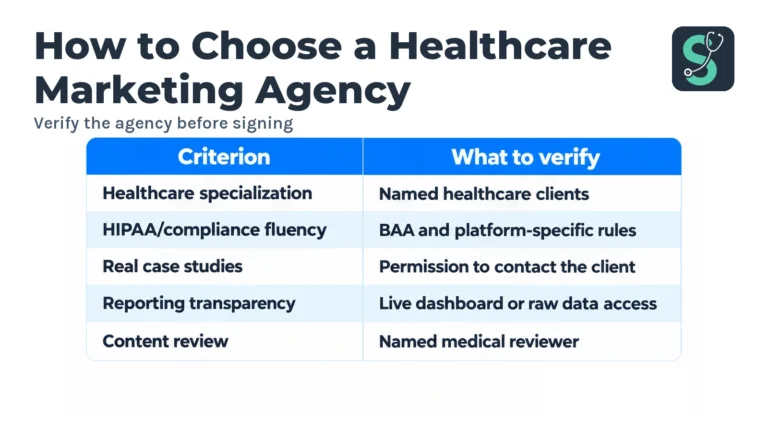
| 1 | Healthcare specialization | Named healthcare clients and healthcare-specific results | Cannot name a single current or past healthcare client |
| 2 | HIPAA/compliance fluency | Will sign a BAA; knows platform-specific rules (e.g. Meta Special Ad Category) | Does not know what a BAA is, or claims “we’re fully HIPAA certified” (no such certification exists) |
| 3 | Real case studies | Permission to contact the client directly | Refuses any client contact or offers only anonymized “a client saw X%” claims |
| 4 | Attribution/reporting transparency | Live dashboard or raw data access, not just a monthly PDF | Reporting is a screenshot deck with no source-of-truth access |
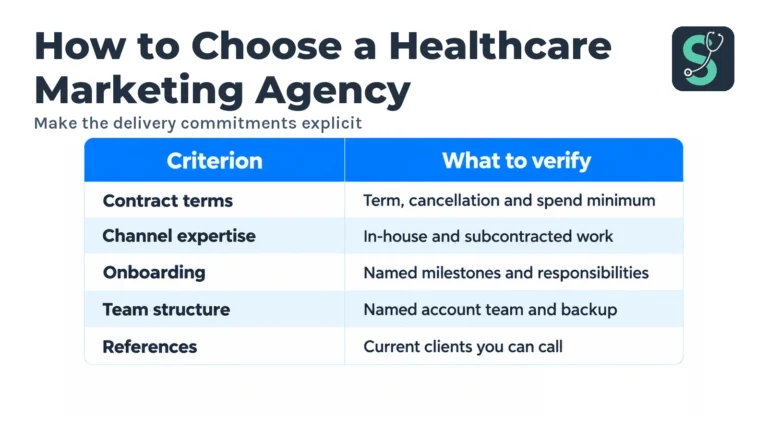
| 5 | Contract terms and minimums | Term length, spend minimum, cancellation notice, in writing | 12-month lock-in with no early-exit clause and vague cancellation language |
| 6 | Channel expertise breadth | Which channels are run in-house vs. subcontracted | Every channel is quietly subcontracted with no visibility into who does the work |
| 7 | Content/medical-review process | Named reviewer, credentials, review workflow | Volume-based content production with no named reviewer at any stage |
| 8 | Pricing transparency | A clear, itemized quote or range after the first call | “It depends” with no number after two calls |
| 9 | Onboarding process | Documented 30-60-90 day plan with named milestones | No onboarding plan; “we’ll figure it out together” |
| 10 | Team structure | Agency vs. freelancer vs. in-house hybrid, named account team | A solo freelancer billing under an agency name with no backup coverage |
| 11 | Platform certifications | Google Ads, Meta Blueprint, and category-specific credentials where relevant | No certifications, or certifications that cannot be verified |
| 12 | References you can call | 2-3 current clients willing to speak by phone | “We don’t give out references” as a blanket policy |
Most agencies pass three or four of these on the first call. The ones worth hiring pass at least nine.
Specialization and compliance: the first two filters
Every agency lists SEO, paid ads, Google Business Profile and reviews, content and web design. The difference is proven results in a regulated category, where the wrong ad targeting or lead-form field creates legal exposure, not just wasted spend.
Criterion 1: Healthcare specialization vs. generalist. Ask how many current clients are healthcare practices and what those accounts achieved. Generalists rarely anticipate the category’s failure modes: a symptom-quiz lead form that trips the HIPAA Marketing Rule, a Meta campaign in the wrong ad category, or review tactics that violate the FTC Consumer Reviews Rule (16 CFR Part 465). These surface months later as account suspensions or compliance letters.
The Stethon Take: a 200-client generalist with three healthcare accounts has less relevant expertise than a 12-client healthcare-only boutique. Ask what fraction of clients are healthcare; a firm that can’t answer offhand is making a marketing claim.
Criterion 2: HIPAA and compliance fluency. Ask whether the agency will sign a Business Associate Agreement before any patient data, including form submissions and call recordings, touches its tools. Hesitation, or a claim to be “HIPAA certified” (no such blanket certification exists under the HIPAA Security Rule), is a red flag. Fluent agencies also know the specifics: Meta’s Special Ad Categories (financial products and services, employment, housing, social issues, elections or politics) don’t include mental health by default, and senior-living ads marketing a residence run under Housing. Google and Meta permanently ban categories including compounded peptides, NAD+, stem cell and exosome “regenerative” claims, hCG for weight loss, and prescription opioids (Stethon compliance runbook, verified 2026-05-06). TikTok blocks all paid telehealth and mental health ads with no certification path; organic content is unrestricted.
The Stethon Way: we check every campaign before launch against a written compliance runbook covering platform eligibility, permanent bans and framing traps like “anti-aging” language, before/after photos and symptom-quiz lead forms. A mid-flight suspension almost always costs more than the review.
Proof and transparency: case studies, attribution, and the guarantee red flag
Criterion 3: Real case studies with permission to verify. Ask to speak directly with the practice owner or marketing lead behind a pitched case study. Confident agencies make the introduction within days. Stalling, offering a written testimonial instead, or redirecting to an unrelated client says something about how the numbers were produced.
Criterion 4: Attribution and reporting transparency. A monthly PDF of screenshots is not reporting. Ask for direct access to GA4, Google Ads or Meta Ads Manager, call tracking and rank tracking. In healthcare the real conversion, a booked appointment, often lives in a practice management system the agency doesn’t control, and reconciling platform “leads” with booked patients is where most attribution claims fall apart.
The Stethon Take: agencies reporting clicks, impressions or “leads” instead of booked, kept appointments are reporting activity, not outcomes. Insist on outcome-level visibility from day one.
What we won’t do: guarantee a #1 ranking. No agency controls Google’s, Bing’s or an AI assistant’s algorithm. A promised position, rather than specific actions and a realistic timeline, is the most common red flag in healthcare marketing sales calls and reason enough to walk away.
Contract terms, channel breadth, and the content review process
Criterion 5: Contract terms and minimums. Get term length, spend minimum and cancellation notice in writing before signing. A quote far below market for comparable scope usually hides freelancer-grade delivery, marked-up subcontracting or a longer minimum than advertised.
Criterion 6: Channel expertise breadth. Ask which channels are in-house and which are subcontracted, and meet the person who will run the account day to day. Many agencies claim SEO, paid search, social ads, content and web design; fewer staff all five well. Subcontracting is fine if the agency discloses it upfront and accountability is clear.
Criterion 7: Content and medical-review process. Healthcare content informs patient decisions and, in some verticals, falls under search engines’ YMYL (“your money or your life”) standards. Ask who reviews content before publishing, with what credentials, and whether it’s a documented step. High-volume content with no named reviewer eventually ships an error a competitor or regulator notices first.
Pricing, onboarding, and team structure
Criterion 8: Pricing transparency. No clear number or range after two conversations usually means pricing to your perceived budget, so identical needs get very different prices. An itemized quote, with ad spend separate from the fee, lets you compare firms directly.
Criterion 9: Onboarding process. Get a written 30/60/90-day plan with an owner for each step: access requests, technical audit, baseline reporting, initial campaign build. “We’ll figure it out together” from an agency with dozens of clients is a missing process.
Criterion 10: Team structure. A solo freelancer offers direct access and often lower cost, but no backup if unavailable for weeks. A full agency offers redundancy and broader coverage, but sometimes junior turnover. An in-house hybrid (one internal hire plus an outside specialist for one channel) suits practices large enough for a full-time marketing hire. The mismatch to avoid: agency-level fees for freelancer-level staffing.
The Stethon Take: the biggest hidden risk is invisible turnover. Practices sign with a senior strategist, then get a junior account manager within 90 days. Ask who will be on the account in six months and what happens if they leave.
Platform certifications and references you can actually call
Criterion 11: Platform certifications held. Google Ads and Meta Blueprint certifications are a baseline. Category-specific ones matter more: LegitScript Healthcare Merchant certification, relevant for clinics advertising certain regulated products or services, carries a $975 application fee plus a $2,150 annual fee per website (as of October 2026); other types, such as Addiction Treatment, have their own fees. Generalist agencies rarely know these exist, let alone have walked a client through one.
Criterion 12: References you can actually call. Most prospects skip this, and it catches the most problems. Ask for two to three current clients willing to take a 15-minute call, then ask: has reporting matched what was promised, has the team stayed consistent, and would you sign the same contract again? A flat “no references, policy” is the answer.
The Stethon Take: the agency doesn’t control what a reference says, so one unfiltered call beats any case study. Whether or not you choose Stethon, insist on one before signing anything longer than three months.
FAQ
How long should a healthcare marketing contract run before you can cancel?
There is no universal answer, but the contract length should match the channel. SEO and content programs typically carry 3-6 month minimums because organic results take time to compound. Paid media (PPC, social ads) can reasonably run month-to-month after an initial setup period, since underperformance is visible within weeks, not months. A 12-month lock-in with no early-exit clause on any channel is a term worth negotiating down or walking away from.
What’s the difference between a healthcare marketing agency and a general marketing agency?
The service list often looks identical: SEO, paid ads, content, web design. The difference is operational experience with the category’s specific constraints, HIPAA-aware form and tracking design, platform ad-policy nuances like Meta’s Special Ad Category rules, and content standards for medical claims. A general agency can produce competent generic marketing work; a healthcare-specialized agency has usually already made, and fixed, the category-specific mistakes a generalist has not yet encountered.
Should a healthcare marketing agency sign a Business Associate Agreement (BAA)?
Whenever the agency’s tools or staff could touch protected health information, including certain form fields, call recordings, or patient-adjacent data in a CRM, a BAA should be in place before that data flows. Not every marketing engagement touches PHI directly, but an agency that does not know what a BAA is, or resists the question, has not built the operational discipline healthcare marketing requires. Ask this question on the first call, not after signing.
How many references should you check before signing with an agency?
Two to three current clients, not former ones, is enough to catch a pattern. A single reference could be an outlier in either direction; three current clients willing to speak candidly about reporting accuracy, team consistency, and whether they would re-sign gives a prospect a reliable read. An agency’s blanket refusal to provide any reference contact is itself a meaningful data point.
What certifications should a healthcare marketing agency hold?
Google Ads and Meta Blueprint certifications are a reasonable baseline for any paid media agency. For practices in more regulated categories, category-specific credentials matter more: LegitScript Healthcare Merchant certification ($975 application fee plus $2,150 annual fee per website, as of October 2026) and Addiction Treatment certification (check LegitScript’s current pricing page) are the two most relevant examples. A practice outside those specific categories should focus less on certification badges and more on the agency’s demonstrated compliance fluency during the vetting conversation itself.
Where Stethon fits in this evaluation
Stethon Digital Marketing was built to pass this test: healthcare-only clients, a compliance runbook checked before every launch, itemized quotes scoped on one call, and reporting reconciled with booked appointments. Use this list on any firm, including us. For SEO scope and deliverables, see the healthcare SEO program page.
Editorial disclaimer
Produced by Stethon Digital Marketing (healthcare performance marketing). Updated November 2026.
This guide reflects Stethon Digital Marketing’s operating experience and general industry practice. It is not legal or medical advice, and it does not constitute a compliance opinion for any specific practice. HIPAA applicability, Business Associate Agreement scope, and advertising-platform policy vary by circumstance and change over time; practices should consult qualified legal counsel for compliance specifics before signing any marketing contract.

Stethon Digital Marketing Team
Healthcare SEO, PPC & Paid Social Specialists
Stethon Digital Marketing delivers SEO, PPC and social media advertising for independent healthcare practices across the United States. This guide draws on our hands-on campaign work and the primary sources cited throughout.