How to Market a Home Healthcare Agency (2026 Guide)
How do you market a home healthcare agency?
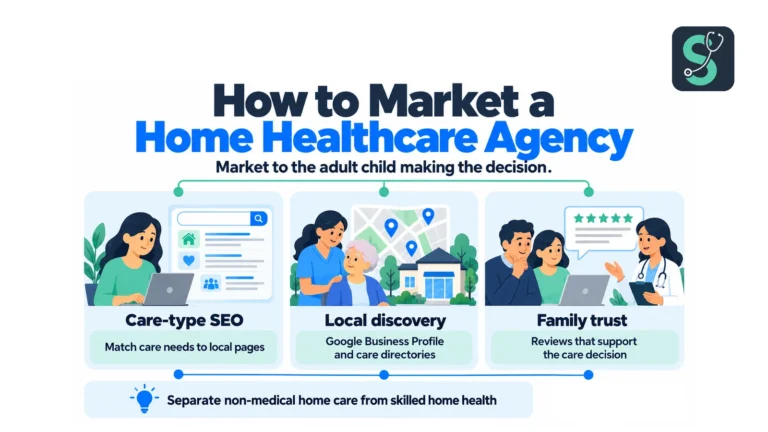
To market a home healthcare agency, win the adult child searching for a parent after a fall or hospital discharge across Google, senior-care directories and reviews, then turn that search into a care start.
Table of Contents
Key takeaways
- Write for the adult child, not the patient: headlines, review replies and ads should answer their anxiety and timeline.
- HIPAA splits the category. Non-medical home care is generally not HIPAA-covered; skilled home health is. Few sites explain it, which makes it a trust signal.
- Directories count as much as the website. Families check A Place for Mom, Caring.com, Home Care Pulse and Caregiver.com against Google reviews.
- Ads are open for home care. Senior-living ads that market a residence run under Meta’s Housing Special Ad Category, which restricts targeting.
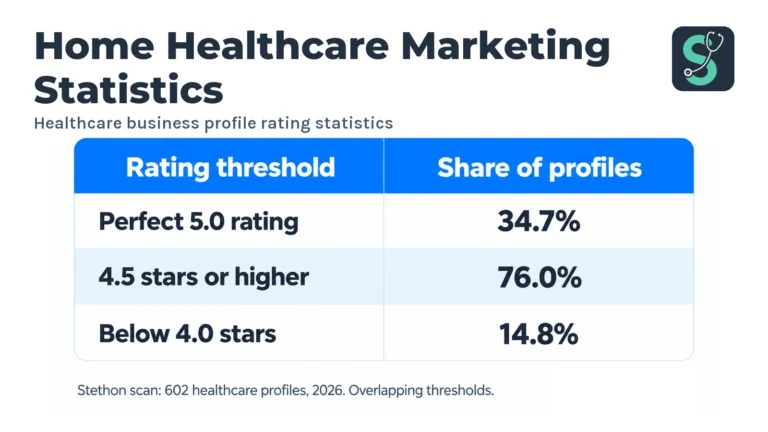
- Reviews set the floor. 76.0% of 602 healthcare profiles Stethon scanned sit at 4.5 or higher (Stethon, 2026); below that, you lose before ads run.
Home care marketing channel quick-diagnostic
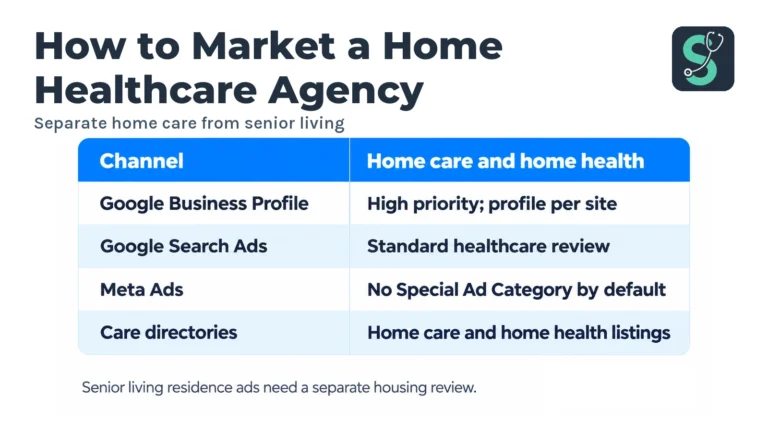
| Channel | Status for home health / non-medical home care | Status for senior living / assisted living |
|---|---|---|
| Google Business Profile | Open, high priority. Multi-location groups need one profile per site. | Open, high priority. |
| Google Search Ads | Open almost everywhere; standard healthcare policy applies. | Open; watch state-specific senior-living ad restrictions. |
| Meta Ads | Open; not a Special Ad Category by default. | Housing Special Ad Category when the ad markets a residence (Meta does not name senior living). No ZIP code, age, or gender targeting. |
| A Place for Mom / Caring.com | Applicable for home care and home health listings. | Primary channel; these directories were built around senior living referrals. |
| TikTok paid | Open for home care; blocked for anything read as telehealth or clinical. | Open, subject to housing-adjacent ad review. |
Start with the real buyer: the adult child, not the patient
Home care marketing usually fails at the first decision: who the copy is for. The patient rarely searches. A daughter out of state, a son handling a discharge or a spouse who can’t manage alone types “home care near me” or “in-home care for dementia,” often at night and under stress, judging trust as much as services.
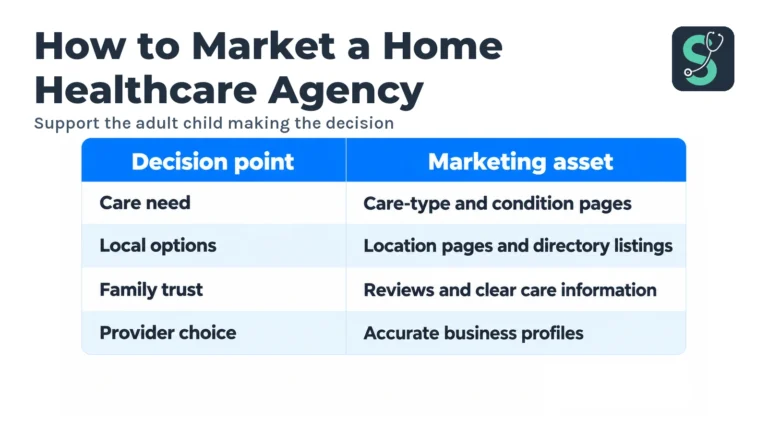
So answer their questions, not the patient’s: “Can I trust the caregiver?”, “What if Mom needs more care later?”, “Can someone start this week?” Generic lines like “Stay independent at home” don’t convert.
The Stethon Take: the homepage’s job is reassurance, not explaining home care. Real caregiver bios and photos, a phone a person answers and a screening explanation above the fold beat a features list in every test we’ve run.
SEO for care type, condition, and location
Home care SEO has three keyword axes: care type (non-medical, skilled home health, companion, live-in, respite, veterans care), condition (dementia and Alzheimer’s, post-surgical, Parkinson’s, stroke, hospice-adjacent support) and location, where pages must match the real staffed radius because families check coverage first.
The head term “home care” has modest volume and low difficulty relative to its CPC. The organic opportunity is real and mostly uncontested, because few agencies build the condition and care-type layer.
- Care-type pages. One page each for non-medical, skilled home health, companion and live-in care, with its own description, pricing framing and FAQ.
- Condition pages. Dementia and Alzheimer’s care is the highest-intent page; diagnosis searchers are further along than generic searchers.
- Real-coverage location pages. Build them only where caregivers are scheduled; unstaffed cities create bad first calls.
GBP, A Place for Mom, and Caring.com: the directory layer families actually use
Families cross-check Google against A Place for Mom, Caring.com, Home Care Pulse and Caregiver.com for reviews and pricing before calling. A strong GBP with thin or unclaimed directory listings loses trust right when it should close.
GBP for home care means Services listed by care type, a service area matching the staffed radius, monitored Q&A and photos of real caregivers, not stock imagery.
The Stethon Way: directories are inventory, not setup. Month one is a listing audit across GBP, A Place for Mom, Caring.com, Home Care Pulse and Caregiver.com; NAP, service tagging and photos are refreshed quarterly. Reviews run through our healthcare reputation management program, adapted to senior-care directories instead of Healthgrades or Zocdoc.
The HIPAA split most home care marketing gets wrong
Few competitors explain this. Non-medical home care (companionship, meals, light housekeeping, transportation, reminders without clinical oversight) is generally not HIPAA-covered. Skilled home health (nursing, PT or OT, wound care under a physician’s plan of care) is, because a covered entity handles PHI as part of treatment.
Three marketing consequences. Intake forms: a skilled home health form asking about diagnosis or medications is PHI from the first field; a non-medical schedule-and-budget form is far lower risk. Testimonials: skilled agencies need explicit authorization before referencing a condition; non-medical agencies have more room, but family privacy still applies. Retargeting: audiences built from skilled home health condition pages carry HIPAA Marketing Rule exposure.
The Stethon Take: this is the most under-marketed differentiator in home care. Most sites bury one generic HIPAA line in the footer. Explaining the non-medical versus skilled distinction in plain language signals operational maturity to families: a trust signal disguised as a compliance note.
Paid ad eligibility: home health is green, senior living is not
Home health and non-medical home care are green-light categories on Google Search and Meta: no permanent ban, no default Special Ad Category, just standard healthcare policy. That makes paid search and social usable growth channels, unlike much of healthcare.
Senior living differs. Meta doesn’t name it in its Special Ad Categories, but ads marketing a residence run under Housing, the category used for real estate. Housing removes detailed age, gender and ZIP targeting and location exclusions, expands city and pin-drop targets to a 15-mile radius and blocks lookalikes. Agencies selling both need two campaign structures.
On Google and Meta, there is no Customer Match, lookalike or remarketing built from health-condition pages such as a dementia care page. TikTok paid ads ban anything read as telehealth or clinical services, but organic caregiver-education content is unrestricted and underused.
Review strategy for a family-trust decision
Reviews weigh more in home care than almost anywhere, because families hand a stranger daily access to a parent. Across 602 healthcare GBPs Stethon scanned in 2026, 34.7% held a perfect 5.0, 76.0% sat at 4.5 or higher and only 14.8% fell below 4.0 (Stethon, 2026). An agency at 4.2 competes against three-quarters of the field at 4.5 or above.
Ask 30 to 60 days into a care start, when the family can judge, and name the individual caregiver, since families want to praise the person. A specific reply to a negative review, especially about scheduling or communication, reassures future families more than ten generic five-stars.
What we won’t do: buy reviews, incentivize them or gate negative feedback away from public platforms. That breaks platform rules and the FTC Consumer Reviews Rule, which carries civil penalties per violation. We build the ask into the care coordinator’s workflow instead.
Multi-location home care groups
Multi-branch groups need a GBP, A Place for Mom and Caring.com listings and a review base per branch, because families judge the office that will staff the case. A shared national profile or review pool reads as inauthentic and often breaks franchisor local-marketing rules.
Give every branch a location page built on its staffed radius, its own listings and branch-level review tracking so weak branches surface early. Allocate budget by local search volume and competition, not an even split.
FAQ
Who is the actual buyer in home care marketing?
In most cases it is the adult child of an aging parent, not the care recipient. This person is typically searching under time pressure after a health event and evaluating trust signals, caregiver screening, and reviews as much as service offerings. Marketing copy, ad angles, and even phone scripts should be written to answer that person’s specific anxieties rather than describing services in the abstract.
Is home care HIPAA-covered?
It depends on the service. Non-medical home care, companionship, meal prep, light housekeeping, is generally not HIPAA-covered because it does not involve a covered entity delivering a clinical plan of care. Skilled home health, nursing, therapy, or wound care ordered under a physician’s plan of care, is HIPAA-covered. Agencies offering both should treat their intake forms, testimonials, and retargeting rules differently for each line of service.
Can home care agencies run paid ads on Google and Meta?
Yes, home health and non-medical home care are open on both platforms almost everywhere, with standard healthcare ad policy applying rather than harder restrictions. Senior living and assisted living campaigns are different: Meta does not name them in its Special Ad Categories, but when an ad markets a residence (a place to live), we run it under Housing, which removes detailed age, gender, and ZIP code targeting and lookalike audiences, and expands city and pin-drop targets to a 15-mile radius.
Which directories matter most for home care beyond Google?
A Place for Mom, Caring.com, Home Care Pulse, and Caregiver.com function as a second search layer for this category. Families routinely check an agency’s Google listing, then cross-reference one or more of these directories for pricing transparency and independent reviews before calling. An agency with a strong Google Business Profile but a thin or unclaimed presence on these directories loses trust right before the decision point.
How important are reviews for a home care agency?
More important than in most healthcare verticals, because the purchase decision is an act of trust transfer into a parent’s home. Across 602 healthcare Google Business Profiles Stethon scanned in 2026, 76.0% held a rating of 4.5 or higher (Stethon, 2026), meaning the competitive floor for this space is already high. A structured review ask 30 to 60 days into a care start, naming the individual caregiver, consistently outperforms a generic request sent at sign-up.
Get the audit before you spend another dollar on ads
Home care marketing works when the copy speaks to the adult child, directories are managed as inventory and the HIPAA split is used as a trust signal. Stethon’s home care marketing program combines all three, backed by our healthcare SEO discipline and healthcare reputation management.
Editorial disclaimer
Produced by Stethon Digital Marketing (healthcare performance marketing). Updated October 2026.
This guide is marketing guidance, not legal or medical advice. HIPAA applicability, ad platform policy, and directory requirements referenced here reflect Stethon’s understanding as of publication and change over time; consult qualified legal counsel for compliance decisions specific to your agency.

Stethon Digital Marketing Team
Healthcare SEO, PPC & Paid Social Specialists
Stethon Digital Marketing delivers SEO, PPC and social media advertising for independent healthcare practices across the United States. This guide draws on our hands-on campaign work and the primary sources cited throughout.