How to Market Regenerative Medicine in 2026: A Compliance-First Patient Acquisition Framework
How do you market regenerative medicine compliantly?
To market regenerative medicine compliantly, avoid FDA-unapproved treatment claims, back every efficacy claim with evidence, and lead with local SEO, education and referrals rather than paid ads that reject stem cell, exosome and peptide claims.
Table of Contents
Key takeaways
- Ad platforms restrict most direct claims about stem cell, exosome, PRP and peptide therapies; compliant messaging still converts.
- Patients research for 3 to 12 weeks before booking, so serve the research journey.
- Strongest 2026 channels: local SEO, YouTube education, physician referrals, email nurture and physician-led health fairs.
- $5,000 to $25,000 protocols support a higher CAC, if retention and upsell are built in from day one.
The regenerative medicine marketing landscape in 2026
Regenerative medicine spans PRP, stem cell, exosome, peptide, hormone and IV therapies for joint pain, hair restoration, recovery, sexual health, anti-aging and inflammation. Demand is growing, and three forces make it hard to market.
Regulatory pressure. The FDA sends warning letters to clinics advertising cures for unapproved indications, and the FTC’s Health Products Compliance Guidance requires competent and reliable scientific evidence for every efficacy claim.
Platform restrictions. Google Ads restricts unapproved pharmaceuticals and sensitive procedures, Meta restricts health claims and before/after images, and TikTok limits some medical aesthetic content. Rejections are often automatic.
Patient skepticism. Patients paying $5,000+ out of pocket research hard, and overclaiming kills trust faster than silence. Strategy starts from these constraints.
The 3 non-negotiable compliance rules before any channel activates
Run every ad, page, email and post through these filters:
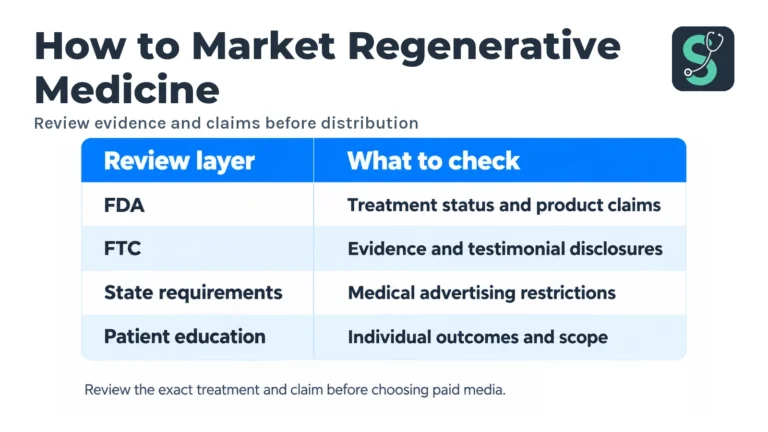
Rule 1. FDA claim limits. Don’t claim to treat, cure, prevent or diagnose a disease unless the therapy is FDA-approved for it; most stem cell, exosome and peptide uses (arthritis, hair loss, anti-aging) are not. Use “supports,” “addresses,” “is being studied for” or “may help manage” instead.
Rule 2. FTC evidence standards. Every efficacy claim needs competent and reliable scientific evidence; testimonials don’t count. Outcome testimonials must be typical or carry a disclosure (“Results vary. Not typical.”). Drop before/after images for unsupported claims.
Rule 3. State medical boards. California, Florida, Texas and New York add rules: some require the physician’s full name and license number on ads, ban superlatives like “best,” or regulate discounts. Check before scaling paid media.
Follow these rules and you can market aggressively. Ignore them and you lose ad accounts, reputation or licenses, usually in that order.
What regenerative medicine patients actually research before booking
Patients research for 3 to 12 weeks before a first consult, across five stages that each need different content:
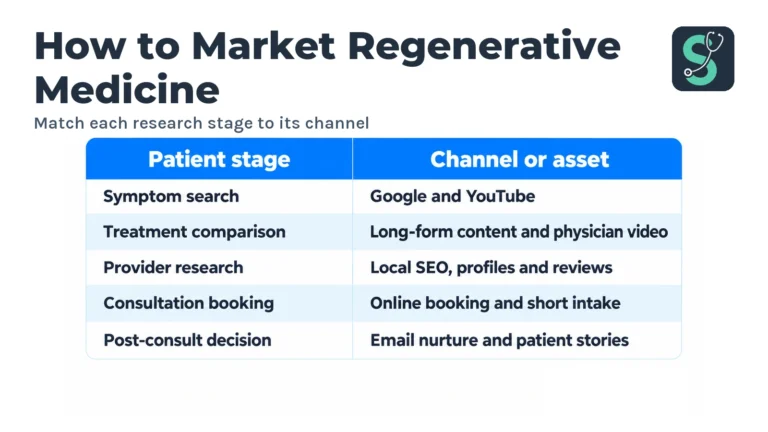
| Stage | What the patient does | Intent | Channels that serve it |
|---|---|---|---|
| 1. Symptom search | Searches “PRP for knee pain,” “stem cell therapy for hair loss” | Informational | Google + YouTube |
| 2. Treatment comparison | Compares regenerative options vs surgery, drugs, alternatives | Transitional | Long-form content, physician video |
| 3. Provider research | Evaluates local clinics: reviews, credentials, pricing | Commercial | Local SEO, GBP, review platforms |
| 4. Consultation booking | Schedules; friction is the enemy | Transactional | Online booking, short intake |
| 5. Post-consult decision | Proceeds or defers | Decision | Email nurture, financing, patient stories |
The 5 strongest marketing channels for regenerative medicine
Ranked by ROI and compliance headroom in 2026:
1. Local SEO + Google Business Profile. The dominant channel. Searches like “PRP treatment [city]” or “stem cell therapy near me” are high intent. GBP optimization, consistent NAP on Healthgrades, Vitals, WebMD and RateMDs, review velocity and city service pages drive most qualified inquiries, with low compliance risk. Benchmarks: healthcare local SEO statistics.
2. YouTube education. Patients watch 15 to 40 minutes of physician-led explainers before booking. Winning topics: “What to expect at a PRP treatment,” “Stem cell therapy for knee pain: what the research shows,” “Peptide therapy side effects.” Few clinics publish consistently, so the channel is underserved.
3. Physician referral networks. Orthopedists, chiropractors, primary care, pain management and functional medicine clinicians refer regenerative patients. One-page clinical briefings and case collaboration build referrals no ad platform can suppress.
4. Email nurture. The long research window makes email the highest-ROI direct channel: weekly education, compliant patient stories, procedure explainers and financing options.
5. Physician-led health fairs. Clinicians explain procedures face to face without platform limits, and most clinics book consults below paid-digital CAC. Playbook below.
How to market regenerative medicine at a health fair
Health fairs let a clinic explain protocols one to one with no ad-policy rejection. Done right, one event books consultations; done wrong, it burns the booth fee. Seven steps:
- 1. Pick the right venue. 55+ communities, performance centers, CrossFit gyms, corporate wellness programs and chiropractic or PT open houses. Generic mall fairs underperform.
- 2. Get a corner booth near the entrance or a complementary provider.
- 3. Bring the physician. Patients weighing a $5,000+ protocol want to meet the clinician; staff-only booths convert far worse.
- 4. Teach, don’t discount. A one-minute “how PRP works” beats a “$500 off” flyer with skeptical patients.
- 5. Use structured intake: HIPAA-compliant tablet screening for symptoms, prior treatments, insurance and availability.
- 6. Book on-site. Same-day scheduling converts 3 to 5 times better than a callback, so bring a scheduler.
- 7. Follow up within 48 hours with a personalized email tied to an event landing page.
Stethon take: health fairs fit regenerative medicine because the consideration window is long and patients want to meet the physician before spending five figures.
The best marketing strategy for regenerative medicine, sequenced
Build a compliance-first stack anchored by local SEO: YouTube and referrals carry the middle of the funnel, and email plus health fairs book the consult. In order:
| Phase | Build priority |
|---|---|
| Months 1-2 | Compliance audit of all existing marketing; local SEO foundation; GBP optimization; healthcare directory citations |
| Months 2-4 | Content production for symptom-search queries; YouTube channel launch with physician-led explainers |
| Months 3-6 | Referral network formalization; outreach to complementary providers with clinical briefings |
| Months 4-8 | Email nurture deployment; patient-journey content with FTC-compliant disclosures |
| Months 6+ | Health fair circuit; paid media layered on top of the organic foundation with legal-reviewed creative |
Compliant ad copy examples vs non-compliant
| Category | Non-compliant | Compliant |
|---|---|---|
| Stem cell arthritis claim | “Stem cell therapy cures arthritis” | “Regenerative therapy may support joint function. Ask our physicians if you’re a candidate” |
| Hair restoration | “PRP grows hair back guaranteed” | “PRP is used as an adjunct in hair-restoration protocols” |
| Anti-aging | “Reverse aging with exosomes” | “Exosome therapy is being studied for cellular-support applications” |
| Peptide therapy | “BPC-157 heals any injury” | “Peptide therapy is one protocol in our regenerative medicine practice. Consultation required.” |
| Testimonial framing | “Patient lost 40 pounds on our peptide protocol” | “Patient case. Results vary. Individual outcomes depend on many factors.” |
| Superlative | “The best stem cell clinic in Miami” | “A healthcare practice offering regenerative medicine in Miami” (where states restrict superlatives) |
ROI math for regenerative medicine marketing
Higher ticket values support a higher CAC. Net monthly return = (patient lifetime value x consult-to-protocol rate x consults per month) minus monthly marketing cost.
Example: a PRP and peptide clinic with an $8,000 lifetime value, 35% consult-to-protocol conversion and 25 consults a month earns $70,000. Against $10,000 a month in marketing, that is $60,000 net, a 7x return.
Consult-to-protocol conversion breaks the math, not CAC. If patients book but don’t convert, fix the consult script and clinical close before scaling spend.
FAQ
How much does it cost to market a regenerative medicine clinic?
Budget depends on locations and market competition, across SEO, content, email, events, and compliant paid media. Single-location clinics with strong referral networks can operate at the lower end. Multi-location groups and clinics in competitive metros pay the higher end. The high ticket values ($5,000 to $25,000 per protocol) support the spend when consult conversion is healthy.
Can I run Google Ads or Meta Ads for stem cell, PRP, or peptide therapy?
Yes, with compliant copy. Google requires claims to avoid unapproved efficacy language and often requires certification for specific procedure categories. Meta restricts before/after imagery, personal-attribute targeting, and certain aesthetic claims; education-first creative focused on provider credibility and consultation booking performs best. Expect rejections during early iteration and work with a team experienced in medical compliance.
How long before regenerative medicine marketing pays for itself?
For SEO and content, most clinics hit break-even by month 4 to 6. For paid media and events, break-even typically arrives in month 2 to 3 if the consultation close rate is above 30%. The bottleneck is almost always consult-to-protocol conversion, not the marketing channel itself.
What is the single most effective channel for regenerative medicine patient acquisition?
Local SEO combined with physician-led YouTube content. The combination serves the long research journey, avoids platform rejection, and compounds over time. Paid channels amplify but rarely lead, because the compliant organic foundation is what converts a 3-to-12-week researcher into a booked consultation.
Do testimonials work for regenerative medicine marketing?
Yes, inside FTC rules. Testimonials are permitted when results are typical or when clearly disclosed as non-typical with proper context. Every testimonial that references an outcome needs a “Results vary. Individual outcomes depend on many factors” disclosure, and testimonials describing specific medical outcomes require supporting evidence the clinic can produce if audited.
Work with a regenerative medicine marketing agency
Clinics that treat regenerative marketing as generic healthcare marketing hit platform rejections and FTC exposure. Stethon runs a compliance-first stack through our regenerative medicine marketing agency program, anchored by the healthcare SEO program and compliant paid media.
Editorial disclaimer
Produced by Stethon Digital Marketing (healthcare performance marketing). Updated October 2026.
This guide is marketing and compliance framing, not legal or medical advice. FDA, FTC, and state medical board requirements change and vary by jurisdiction and therapy; verify current rules with qualified counsel before publishing claims. Nothing here guarantees marketing outcomes.

Stethon Digital Marketing Team
Healthcare SEO, PPC & Paid Social Specialists
Stethon Digital Marketing delivers SEO, PPC and social media advertising for independent healthcare practices across the United States. This guide draws on our hands-on campaign work and the primary sources cited throughout.