Ethical Healthcare Marketing: Sensitive Services & Patient Trust
What is ethical healthcare marketing?
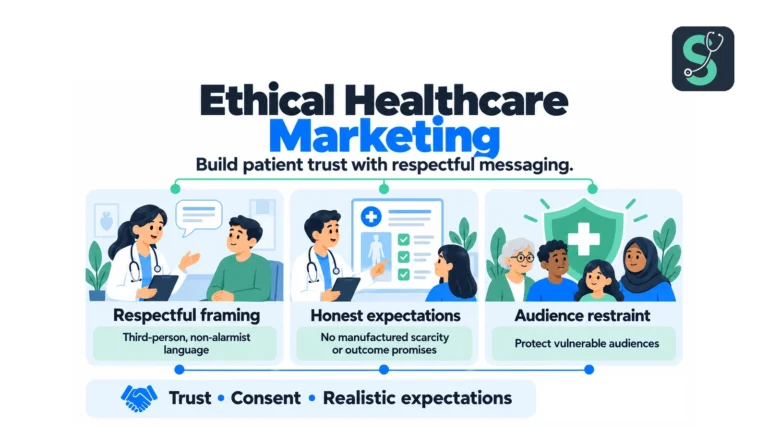
Ethical healthcare marketing promotes sensitive services (mental health, addiction, fertility, weight loss, plastic surgery) without exploiting fear, shame or vulnerability. It sets a higher bar than platform policy: an ad can pass every Meta and Google check and still erode patient trust.
Table of Contents
Key takeaways
- Compliant isn’t ethical: ads can pass every policy check and still sell to fear, shame or desperation.
- Third person wins on trust: “many people experience…” beats “are YOU suffering from…,” not just on policy risk.
- Hold before/after photos above the platform floor, especially in fertility, weight loss and plastic surgery.
- Restrain targeting around grief, addiction, body image and fertility even when the option exists.
- Trust drives referrals in these categories, because patients talk to each other.
Sensitive category diagnostic: common exploitative pattern vs. the ethical standard
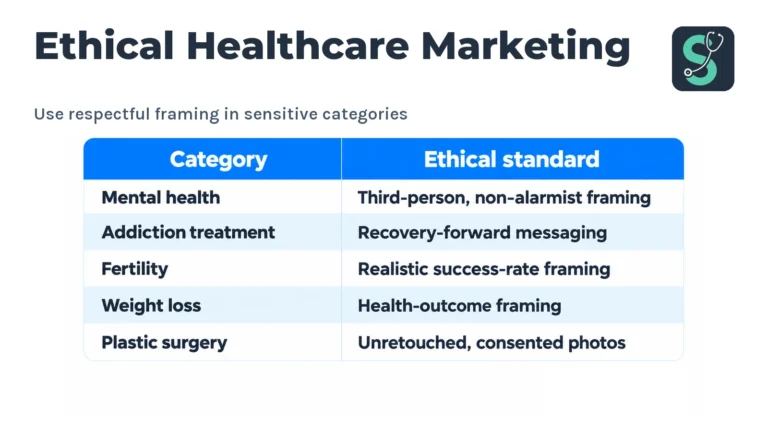
| Sensitive category | Common exploitative pattern | Ethical standard |
|---|---|---|
| Mental health | “Are YOU depressed, anxious, or in crisis?” direct-address hooks | Third-person, non-alarmist framing; no crisis language in ad copy |
| Addiction treatment | Rock-bottom imagery, urgency countdowns (“beds fill fast”) | Recovery-forward messaging, no manufactured scarcity |
| Fertility | Age-shaming copy, guaranteed-outcome language | Realistic success-rate framing, no outcome guarantees |
| Weight loss | Before/after transformation ads targeting body-image insecurity | Health-outcome framing over aesthetic-shame framing |
| Plastic surgery | Heavily retouched before/after pairs, comparison-shaming copy | Unretouched, consented photos with realistic-expectation disclosure |
Why shame and fear-based hooks fail patients, and the practice
Shame and fear hooks dominate sensitive-category ads because they win short-term A/B tests. That is the problem: the winning hook often recruits the wrong patient at the wrong moment for the wrong reason.
In these categories, the reader is often deciding whether to seek help at all. Manufactured shame fights their ambivalence instead of resolving it: it can produce a form fill, but rarely a patient who stays in treatment, keeps follow-ups or refers a friend.
The Stethon Take: Meta will approve isolation and crisis language that avoids specific banned phrases. Passing review isn’t the bar; platforms optimize for policy risk, not patient outcomes, so the agency must hold a higher line.
Third-person framing vs. “are YOU suffering from X”
Test who the sentence speaks to. “Are YOU struggling with anxiety?” asks the reader to self-diagnose in a public feed, possibly on a shared device. “Many adults experience anxiety that interferes with daily life” lets them recognize themselves privately, or not at all.
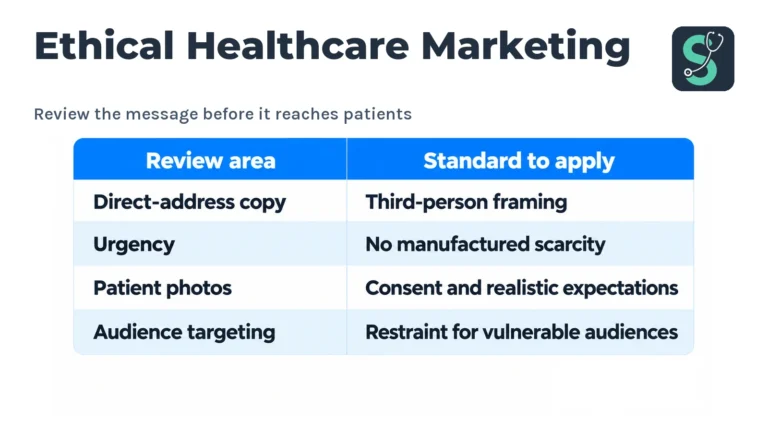
Meta flags direct-address health copy more aggressively because it implies a diagnosis about the viewer, the concern behind its Personal Attributes and Health and Wellness policies. But we use third person because it respects the reader’s autonomy, not because it clears review.
“Struggling to get pregnant?” and “Tired of hiding your body?” ask readers to confirm a painful state publicly. “One in eight couples experiences infertility” states the fact without demanding a raised hand.
The Stethon Take: “are YOU” copy persists because nobody measures its downstream cost: slightly higher CTR, meaningfully worse patients who arrive carrying the shame the ad used to recruit them.
Before/after photo ethics beyond the policy floor
Before/after photos can turn a legal service into a policy violation through implied cure or guaranteed outcomes. That is the policy floor; the ethical floor sits higher and applies even to photos a platform would approve.
Three rules beyond policy: no retouching or lighting that exaggerates the clinical result; written, use-specific consent (organic post, paid ad and website gallery are separate permissions); and no copy implying the after photo is typical or guaranteed. Plastic surgery and weight loss break these most, because the format converts best there.
The Stethon Way: every before/after asset needs a signed, use-specific consent form, and pairs with mismatched lighting, angle or retouching are rejected. If a client’s photos can’t meet that bar, the campaign runs without them.
Restraint in targeting vulnerable audiences
Platforms block Customer Match, lookalikes and audience expansion from health-condition visitors. That is a floor. Grief, addiction, body image and fertility involve emotional states ad systems can’t see, so restraint has to come from the marketer.
Interest targeting around “divorce,” “grief support” or “fertility struggles” is available and not blocked, but it hits people at their most vulnerable with a commercial message. Availability isn’t permission. Condition searches, provider comparisons, insurance and location intent build effective campaigns without anchoring on someone’s grief or fertility calendar.
Addiction is the sharpest case. Retargeting a 2am “detox near me” searcher with an urgency ad an hour later is legal and effective short term, and it targets a possible crisis moment with a closing pitch. We build addiction campaigns on steady visibility, search intent and organic authority instead.
What we won’t do: shame-based hooks
We don’t write shame hooks for any sensitive category: no body shaming in weight loss or plastic surgery, no failure framing in fertility (“why isn’t it working”), no crisis framing in mental health or addiction. It is a written standard enforced at copy review.
The commercial case is simple: shame-recruited patients arrive defensive, drop out early and rarely refer. Sensitive service lines live on word of mouth more than any specialty, so trading referrals for short-term clicks is a bad deal before ethics even enter.
Why ethical sensitive-category marketing wins on trust
Restraint costs the wrong conversions and protects the right ones. A fertility patient who booked after a privacy-respecting ad with a realistic success-rate range arrives trusting you; one recruited by a guaranteed-outcome ad arrives with expectations the team must walk back.
It compounds in trust-dense specialties where patients disclose sensitive information and stay in longer care. Stethon’s research across 22,614 clinic pages found mental health sites cover just 0.237 of patient-decision topics against a 1.0 benchmark (Stethon, 2026): most sites don’t answer the questions patients need before calling. Urgency ads solve the wrong problem.
The Stethon Take: the industry’s failure is laziness dressed up as performance marketing. Shame hooks are easy to write and test; restraint-first messaging takes discipline and a longer runway, and clients rarely ask which they’re getting.
FAQ
What is ethical healthcare marketing?
Ethical healthcare marketing is the practice of promoting medical and behavioral health services without exploiting fear, shame, or a patient’s vulnerability to generate a lead. It applies most directly to sensitive categories: mental health, addiction treatment, fertility, weight loss, and plastic surgery. It is a standard set above platform ad policy, since policy compliance alone does not prevent shame-based or fear-based messaging.
Is “are YOU suffering from X” ad copy against the rules?
Direct-address health copy is not automatically banned on most platforms, but it draws heavier ad-review scrutiny than third-person, observational framing because it implies a diagnosis about the specific viewer. Beyond the compliance question, Stethon treats third-person framing as the ethical default because it lets a reader recognize themselves privately rather than forcing a public self-diagnosis in a feed.
Are before/after photos allowed in healthcare advertising?
Before/after photos are allowed on most platforms with restrictions and are one of the framings most likely to trigger a policy review, particularly when paired with cure or guaranteed-outcome language. Stethon’s ethical standard exceeds the policy floor: no retouching that widens the visual gap, use-specific written consent for every asset, and no copy implying a typical or guaranteed result.
Can healthcare ads target people going through grief or addiction?
Some interest-based targeting around grief, divorce, or addiction-adjacent behavior is technically available on ad platforms and is not blocked outright by policy, separate from the hard restrictions on retargeting off health-condition website visitors. Stethon’s position is that technical availability is not the same as an ethical green light, and campaigns in these categories should be built on broader intent and search signals rather than moment-of-vulnerability targeting.
Does ethical marketing actually convert worse than aggressive tactics?
Shame-based and fear-based hooks can produce a higher short-term click-through rate in an A/B test, but sensitive-category specialties depend heavily on patient retention and referral, not one-time conversion. Stethon’s view is that a campaign optimized purely for click-through in these categories is optimizing for the wrong metric, since a patient recruited through shame is statistically more likely to disengage early and never refer another patient.
Build a sensitive-category marketing program that holds up
Sensitive categories need marketing that respects vulnerability instead of monetizing it, on both the legal layer, covered in our HIPAA and privacy compliance guide, and the ethical layer above. Our mental health marketing program is built on third-person framing, targeting restraint and creative review that rejects shame hooks.
Editorial disclaimer
Produced by Stethon Digital Marketing (healthcare performance marketing). Updated November 2026.
This guide reflects Stethon Digital Marketing’s marketing and creative standards and is not legal or medical advice. Platform ad policies change frequently and vary by category and account history; consult qualified legal counsel for compliance-specific determinations before launching a sensitive-category campaign.

Stethon Digital Marketing Team
Healthcare SEO, PPC & Paid Social Specialists
Stethon Digital Marketing delivers SEO, PPC and social media advertising for independent healthcare practices across the United States. This guide draws on our hands-on campaign work and the primary sources cited throughout.