
Healthcare Marketing Tech Stack: CRM, Attribution & the KPIs That Actually Matter
What should a healthcare marketing tech stack include?
A healthcare marketing tech stack is the CRM, call tracking, GA4/Google Tag Manager and reporting layer that connect a lead to a booked, kept appointment. Most practices own the pieces; few have them wired together.

Table of Contents
Key takeaways
- CRM: it must log call and form source at the field level; a generic sales CRM without those fields produces reports nobody can trust.
- Call tracking: phone calls are still the dominant healthcare conversion, so call tracking is a reporting requirement, not an add-on.
- CPL vs. CPBP: cost per lead and cost per booked patient are different numbers, and only the second touches revenue.
- MQL vs. kept appointment: collapsing them into one line item is the most common reporting distortion in healthcare marketing.
- Dashboards: traffic and impressions measure activity; booked patients and cost per acquisition measure the business.
| Metric | Definition | Why it matters | Common mistake |
|---|---|---|---|
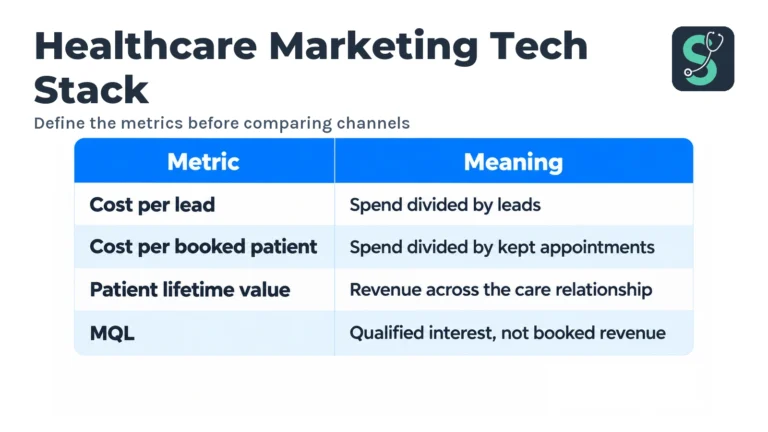
| Cost per lead (CPL) | Total marketing spend divided by total leads generated | Baseline efficiency metric across channels and campaigns | Comparing CPL across channels without normalizing for lead quality |
| Cost per booked patient (CPBP) | Total spend divided by patients who actually scheduled and kept an appointment | The number that ties spend to revenue, not just interest | Reporting CPL as though it were CPBP |
| Patient lifetime value (LTV) | Average revenue per patient across the full treatment relationship, not one visit | Sets the ceiling on what a practice can spend to acquire one patient | Using single-visit revenue instead of the full relationship |
| MQL | A lead matching ideal-patient criteria that has engaged: a form fill, a call, a chat | Signals the top of funnel is producing qualified interest | Reporting MQL volume as though it equals booked revenue |
| Scheduled / kept appointment | A patient who booked and actually showed up, or completed a telehealth visit | The real revenue-generating event marketing is paid to produce | Treating “scheduled” as equivalent to “kept,” ignoring no-show rate |
| Attribution window | The time period during which a touchpoint receives credit for a conversion | Wrong window over-credits or under-credits specific channels | Using a default 30-day last-click window against a multi-month healthcare buying cycle |
CRM Systems for Healthcare Practices
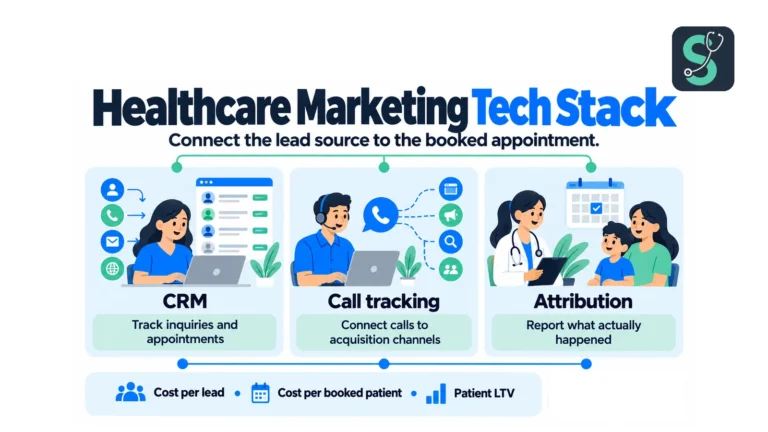
General sales CRMs track deals. A practice needs to track a patient journey from call or form to scheduling, referrals, recalls and repeat visits. NexHealth, Weave and PatientPop build scheduling, patient communication and reputation tools into the CRM, cutting manual front-desk handoffs.
Field structure matters more than brand. The CRM needs a required “lead source” field at intake, the campaign or call-tracking number behind each contact, and a pipeline that separates “inquiry,” “scheduled,” “kept appointment” and “no-show.” Without those, it’s a contact list, not a measurement tool.
The Stethon Take: most practices buy a CRM for scheduling and messaging and never configure the reporting fields. Choose the fields first, then the software. A tool that can’t tell you where a patient came from is a cost center, not a marketing asset.
Call Tracking: Why It Matters More in Healthcare Than Most Industries
Most measurement assumes an online conversion. In healthcare, patients tap the number in a Google Business Profile listing or a Google Ads call extension and book by phone. Tracking only forms measures a fraction of demand.
Call tracking assigns a unique number to each channel, campaign or ad group. Dynamic number insertion (DNI) swaps numbers on the website by referral source, so Google Ads and organic visitors see different numbers on the same page. Call recording shows whether the front desk booked the caller, which is where most lead-to-appointment loss happens.
Recordings capture protected health information as soon as a caller mentions a symptom or condition, so the vendor must sign a Business Associate Agreement (BAA) and the practice needs a retention and redaction policy for recordings.
GA4 and Google Tag Manager Setup for Healthcare Sites
GA4’s event-based model suits healthcare because a practice defines exactly what counts as a conversion: a form submission, call-tracking click, chat start or appointment-widget completion. The work is defining those events consistently across every page, not installing the code.
Google Tag Manager (GTM) fires those events without a developer editing page code. A healthcare setup needs cross-domain tracking when scheduling runs on a separate platform (Zocdoc, NexHealth, a portal subdomain), consent mode for cookie banners, and a server-side GTM container for tighter control over what reaches Google. A misconfigured event here can leak more than a mistracked purchase.
HIPAA-Aware Analytics Configuration
GA4 and GTM aren’t inherently HIPAA-safe or unsafe; the risk is what you send them. A URL parameter with a patient name, a form field passing a diagnosis into the data layer, or a condition-revealing page path (a “depression treatment” landing page) becomes a PHI disclosure once it reaches a third-party platform without a BAA. Strip identifiable and condition-specific data before it leaves the practice’s systems.
For BAAs, PHI in marketing and platform-by-platform tracking rules, see how healthcare marketing agencies handle HIPAA, privacy, and compliance.
Lead-Source Attribution and Appointment Tracking
A patient may see a Google Ads listing, later click an organic result, ask a friend, then call the number on a direct mail piece months later. A last-click model credits the mailer with the whole booking. Buying cycles beyond urgent care stretch for weeks or months, breaking the default 30-day attribution window most ad platforms assume.
No perfect model exists for a phone-heavy, offline-closing business, so close the loop between front desk and ad platforms: unique call-tracking numbers per channel, a mandatory “how did you hear about us” field checked against the number dialed, and offline conversion imports that push booked and kept appointments from the CRM pipeline (inquiry, scheduled, kept, no-show) into Google Ads and Meta. Without that sync, platforms optimize for clicks, not patients.
What we won’t do: build retargeting or lookalike audiences from visitors to health-condition pages such as “depression treatment” or “addiction recovery.” It violates ad platform health-content policy and crosses an ethical line regardless, because it treats a search for care as targetable data.
The KPI Stack: Cost Per Lead, Cost Per Booked Patient, Patient LTV, and the MQL Trap
Cost per lead and cost per booked patient
Cost per lead (CPL) is spend divided by leads, useful for comparing raw channel efficiency. Cost per booked patient (CPBP) is spend divided by patients who scheduled and kept an appointment, and it connects to revenue. A low-CPL campaign with a high no-show rate can still lose money, and CPL-only reporting never shows it.
Patient lifetime value
Patient LTV is average revenue per visit × average visits per year × average years retained. It sets the real ceiling on acquisition spend: a high-LTV practice can justify a much higher CPBP than a low-LTV one. A budget conversation that skips it is guessing.
MQL vs. scheduled appointment: the distinction practices get wrong
An MQL matches ideal-patient criteria and has taken an engagement action: a form, a tracked call, a chat. A kept appointment is a patient who booked and showed up, or completed a telehealth visit. Front-desk conversion rate and no-show rate separate the two, and both vary enormously by practice.
The Stethon Take: this is the most commonly confused metric pair in healthcare reporting, often on purpose. “500 leads this month” sounds better than “500 leads, 190 scheduled, 140 kept,” but only the last number represents money. An agency that headlines MQL volume without scheduled and kept numbers is either not measuring the full funnel or hiding the part that looks worse. Ask for those numbers by name in every report.
Reporting Dashboards: What Actually Matters vs. Vanity Metrics
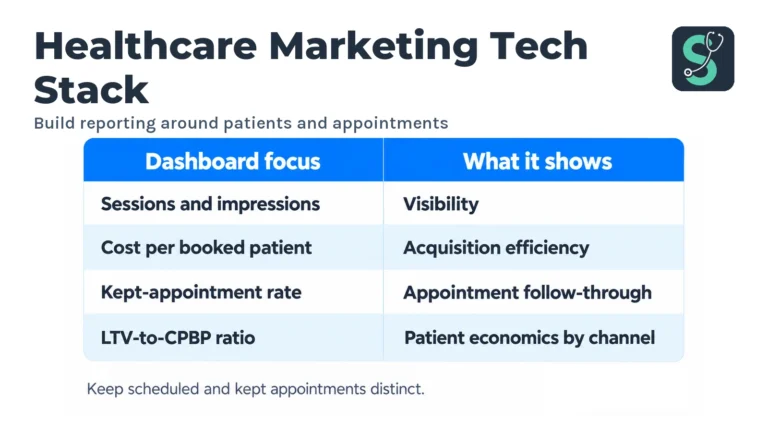
A vanity dashboard leads with sessions, impressions and click-through rate: easy to make look good, and silent on whether the phone rang with a patient worth keeping. A useful dashboard leads with leads, scheduled and kept appointments by source, cost per booked patient by channel, and no-show rate. Traffic is supporting context, not the headline.
| Dashboard type | Leads with | Tells you |
|---|---|---|
| Vanity dashboard | Sessions, impressions, CTR, pageviews | Whether ads and content are being seen |
| Useful dashboard | Cost per booked patient, kept-appointment rate, LTV-to-CPBP ratio by channel | Whether spend is producing patients the practice can afford to acquire |
The Stethon Take: most healthcare marketing reports are built to impress, and the tell is numbers that rise every month whether or not the practice grows. Impressions rise with spend; sessions rise with content. A report worth acting on answers one question: how many patients did each dollar produce, at what cost per patient, compared to what that patient is worth?
The Stethon Way: every Stethon client on PPC or Social Ads gets call tracking and CRM source fields configured before the first billing cycle closes. Every client gets the same monthly report: leads, scheduled and kept by source, and cost per booked patient by channel. A negotiable format drifts toward whatever number looks best.
FAQ
What CRM should a healthcare practice use for marketing tracking?
The specific platform matters less than the field structure. A practice needs a required lead-source field, a link to the call-tracking number or campaign that generated the contact, and a pipeline stage that separates inquiry, scheduled, kept, and no-show. Practice-oriented platforms like NexHealth, Weave, and PatientPop build these fields in by default; a generic sales CRM usually needs to be configured for them manually.
Is call tracking HIPAA compliant?
Call tracking itself is not automatically compliant or non-compliant, it depends on the vendor and configuration. Because a recorded call can capture a caller mentioning symptoms or a condition, a practice needs a call-tracking vendor willing to sign a Business Associate Agreement (BAA) and a defined retention policy for recordings. Without a BAA in place, recorded calls containing PHI create real exposure under the HIPAA Security Rule.
How do you attribute a booked appointment to the channel that generated it?
No single attribution model perfectly solves this for a phone-heavy, multi-touch, often offline-closing business like a healthcare practice. The practical approach combines unique call-tracking numbers per channel, an intake field capturing how the patient heard about the practice, and offline conversion imports that feed scheduled and kept appointment data back into the ad platforms so their bidding systems optimize toward patients rather than clicks.
What’s the difference between a marketing qualified lead and a scheduled appointment?
An MQL is a lead that matches ideal-patient criteria and has engaged through a form, call, or chat. A scheduled appointment is a patient who has actually booked a time, and a kept appointment is a patient who showed up or completed a telehealth visit. Reporting MQL volume without also reporting scheduled and kept numbers hides the front-desk conversion rate and no-show rate, both of which determine whether a lead ever becomes revenue.
What KPIs should a healthcare practice actually track?
At minimum: cost per lead, cost per booked patient, kept-appointment rate, and patient lifetime value, tracked by channel rather than in aggregate. Cost per booked patient compared against patient LTV determines whether a channel is actually profitable, which is a different question than whether it produces a low cost per lead.
Build a Tech Stack That Reports What Actually Happened
Stethon Digital Marketing builds the CRM fields, call tracking and attribution loop before a client’s first ad dollar is spent, then reports leads, scheduled and kept appointments by channel every month, so you know whether spend produces patients at an acceptable cost.
This article is marketing guidance, not legal or medical advice. Compliance requirements referenced here, including HIPAA and BAA obligations, change and vary by state and situation; consult qualified legal counsel before finalizing any tracking, analytics, or CRM configuration for a healthcare practice.

Stethon Digital Marketing Team
Healthcare SEO, PPC & Paid Social Specialists
Stethon Digital Marketing delivers SEO, PPC and social media advertising for independent healthcare practices across the United States. This guide draws on our hands-on campaign work and the primary sources cited throughout.
Produced by Stethon Digital Marketing (healthcare performance marketing). Updated November 2026.