
Healthcare Marketing for Multi-Location Clinics: The Real Playbook
How should multi-location healthcare practices market?
Multi-location healthcare marketing works on two layers: a central brand, compliance and measurement layer, and a per-location layer of pages, profiles, reviews and budgets. One “locations” page, one ad budget and one review score can’t represent several clinics.

Table of Contents
Key takeaways
- Give every location its own page with unique content, schema and conversion path; a directory page isn’t a strategy.
- Budget by measured local difficulty, not headcount or population.
- GBP breaks past about 10 locations without bulk-management workflows.
- Duplicate location pages are the most common technical failure, and a structured content brief prevents them.
- CEOs and location managers need different reports from the same data.
Single-location vs. multi-location marketing: what changes
| Marketing function | Single location | Multi-location (5+ sites) |
|---|---|---|
| Location pages | One homepage covers the practice | One indexable page per location, unique content, no shared boilerplate |
| Google Business Profile | Managed by hand, individually | Managed via bulk location group tools, standardized templates, delegated local edits |
| Ad budget control | One owner, one account | Split between centralized brand budget and per-location local budget |
| Call tracking | Optional, one number | Required, one tracked number per location minimum |
| Reviews | One aggregate score | Per-location score, per-location response cadence, brand-wide floor |
| Reporting | One dashboard, one owner | Roll-up dashboard for leadership, location-level dashboard for site managers |
Location landing page architecture (and why duplicate content kills it)
The most common mistake is one “our locations” page listing addresses and a map while service content lives on the homepage. It can’t rank for “[specialty] near [city]” and gives patients no reason to trust a specific site.
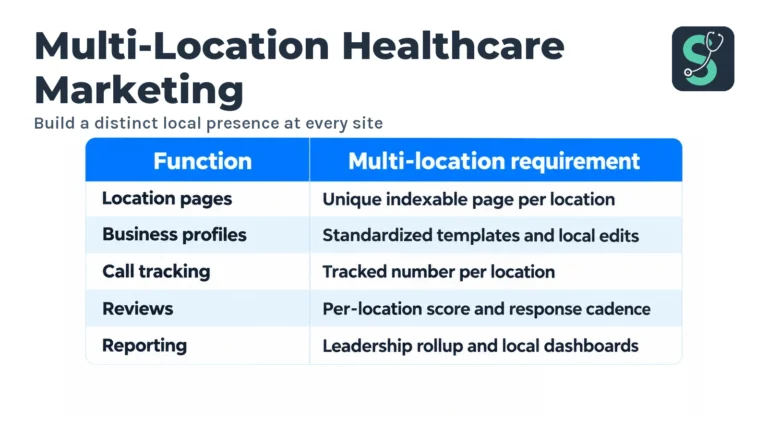
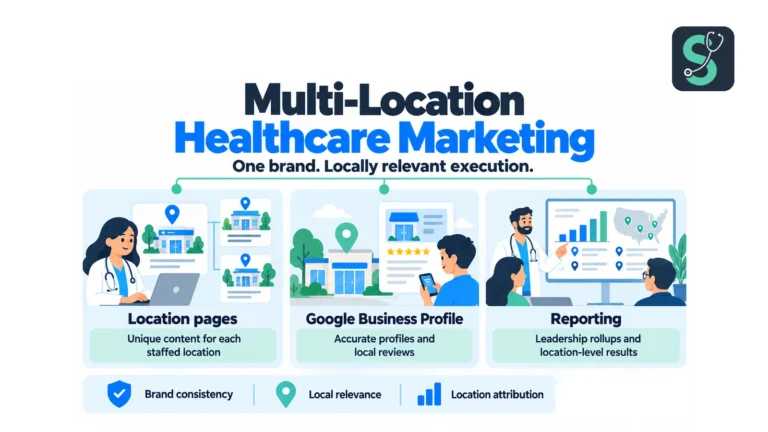
A real location page has its own URL, a title and meta description built on city and specialty, the providers at that site, its services, hours, parking or transit, a neighborhood reference, reviews filtered to that location and a booking path with its own tracked number.
Build 15 pages from one template with only the city swapped and Google typically indexes one, sometimes none. Write a brief per location: unique bios, service emphasis and local proof, with at least 150 to 250 words that couldn’t be pasted onto a sibling page without errors.
The Stethon Take: directory pages survive because they take an afternoon and real location pages take weeks. Flat retainers regardless of location count quietly choose the cheap version, until a competitor with individual pages outranks every location.
Google Business Profile management at scale
One GBP is a part-time task; twenty is a workflow that predictably breaks past about ten: holiday hours go stale, categories drift, photos diverge and review replies slip from same-day to weeks.
Use a location group in Business Profile Manager so bulk edits (holiday hours, messaging, service menus) push everywhere, while local managers edit provider and parking details under a locked template that protects NAP and categories. Apply one review-reply SLA, commonly 24 to 48 hours, at every site.
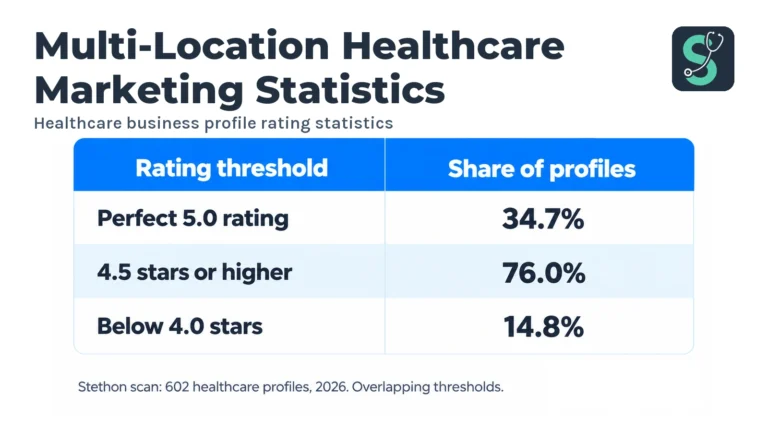
Rating consistency matters at scale. Stethon’s 602-profile scan found 34.7% of healthcare profiles at 5.0, 76.0% at 4.5 or higher and 14.8% below 4.0 (Stethon, 2026). One location at 3.6 among 4.5-plus siblings is a visible weak point and usually an operational problem first.
What we won’t do: incentivize staff to solicit reviews, gate negative feedback or trade perks for reviews. That breaks Google and Meta rules and the FTC Consumer Reviews Rule, with civil penalties per violation. The struggling location tempted to buy parity needs an operational fix instead.
Brand consistency vs. local relevance
Corporate wants one voice, visual system and set of approved claims; locations want to sound like their neighborhood, because patients choose a nearby clinic.
Lock the brand layer (voice, clinical claims, compliance language, logo, colors) and flex the local layer (provider bios, neighborhood references, local photos, hours, parking and which services lead). A retiree-heavy market can lead with different services without touching a compliance-reviewed sentence.
The Stethon Take: most groups lock the wrong layer, policing local photos and bios while letting clinical claims drift. Lock the claims, which carry the legal exposure, and let the local layer flex.
Centralized vs. local advertising management
At 5 locations, one centralized account with location-level campaigns lets a single strategist spot patterns, shift budget to the best-converting site and buy media once. Five separate accounts add overhead without enough scale.
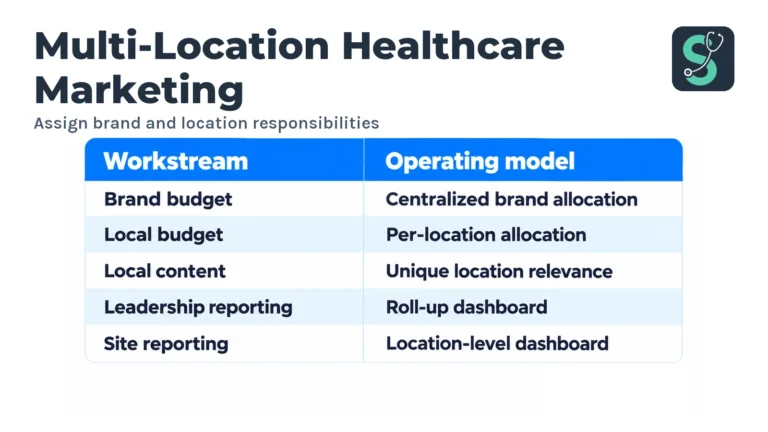
At 50 locations, one account becomes a bottleneck: no strategist holds 50 markets, aggregate bidding underperforms in outliers and creative that wins in one region hurts another. Past roughly 15 to 20 locations, use hub and spoke: a central team owns strategy, brand safety, pacing and shared creative; regional managers allocate local budget within guardrails and choose from pre-approved creative.
The Stethon Way: one PPC management fee covers the central layer (strategy, creative approval, cross-location reallocation), and local managers get a monthly view of their own cost per lead. No per-location fees.
Call tracking, attribution, and difficulty-weighted budget allocation
Past two locations, every site needs its own tracked number (static or dynamic) so booked calls can be attributed to the right location and channel. Otherwise you can’t tell which site or campaign drove a lift.
That data enables real allocation. Most groups split spend by population or revenue, ignoring the variable that sets cost per lead: local competition. A contested metro needs more budget than an identical location in a quiet market.
The Stethon Way: we allocate by measured local difficulty first, population second. Groups that allocate by population underfund their hardest markets, then misread the lead gap as a location problem instead of a budget problem (Stethon, 2026).
Provider and location schema, and reporting rollups
Schema needs two layers: organization schema for the parent brand, and MedicalBusiness or LocalBusiness schema per site with address, hours and coordinates, plus Physician or Person schema per provider linked to the locations where they practice. Search and AI engines use that provider-to-location link; skip it and every provider looks interchangeable.
The CEO wants group totals: new patients, cost per patient and trend. Location managers want their own leads, reviews and call answer rate. Build one roll-up on location-tagged data with per-location filters, and decide call tracking and UTM tagging before the first location page launches, not after location twelve.
FAQ
How many locations before I need a dedicated multi-location marketing strategy?
The break point is usually 3 locations for content and reporting structure, and closer to 10 locations for Google Business Profile management, where manual per-listing updates stop scaling. A 2-location practice can often run on a lightly adapted single-location playbook; a 5-location group cannot.
Should every location get its own website or subdomain?
No. A separate indexable page per location on the main domain outperforms separate microsites or subdomains for almost every healthcare group, because it consolidates domain authority instead of splitting it across properties. Separate domains are rarely justified below 25 to 30 locations or a genuine sub-brand with distinct positioning.
Who should control the ad budget in a multi-location clinic group?
A centralized team should own platform strategy, brand safety, and budget reallocation across locations, while local or regional managers flag underperformance and select from pre-approved creative for their market. Full local autonomy over ad accounts rarely works past 3 to 5 locations in a regulated healthcare vertical.
How do I stop location pages from being flagged as duplicate content?
Write a unique content brief per location covering its specific providers, service emphasis, and local proof points, rather than templating one page and swapping the city name. At minimum 150 to 250 words of page copy should be factually incorrect if pasted onto a sibling location, which is the practical test for whether the content is genuinely unique.
What KPI should a multi-location CEO track vs. a location manager?
A group CEO should track total new patients, blended cost per patient, and quarter-over-quarter trend across the whole group. A location manager should track their own site’s lead volume, review score, and call answer rate. Both views should sit on the same underlying location-tagged data so the numbers reconcile.
Get the multi-location build right the first time
Multi-location failures are architecture failures: one directory page, one unguarded ad account, one review score hiding a struggling site. Our healthcare SEO program builds per-location pages and difficulty-weighted budgets, and healthcare lead generation ties call tracking and attribution together.
Editorial disclaimer
Produced by Stethon Digital Marketing (healthcare performance marketing). Updated November 2026.
This guide is marketing operational guidance, not legal, medical, or compliance advice. Healthcare organizations should consult qualified legal and compliance counsel before implementing any tracking, advertising, or data-handling process referenced here.

Stethon Digital Marketing Team
Healthcare SEO, PPC & Paid Social Specialists
Stethon Digital Marketing delivers SEO, PPC and social media advertising for independent healthcare practices across the United States. This guide draws on our hands-on campaign work and the primary sources cited throughout.